Advances in Temperate Phyconomy: Algal Harvest and Cultivation in Globally Distributed Temperate Waters, Gebunden
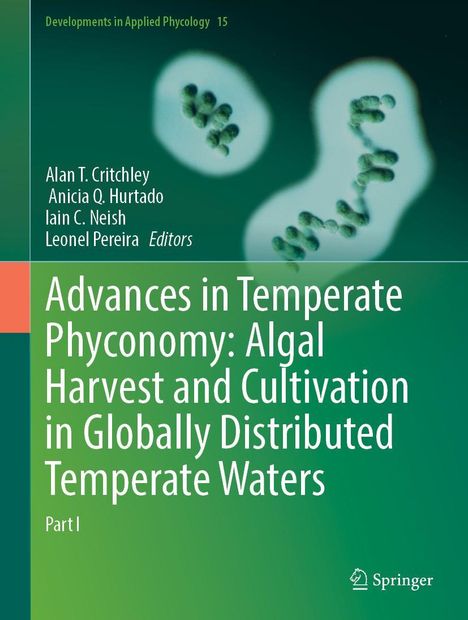
Advances in Temperate Phyconomy: Algal Harvest and Cultivation in Globally Distributed Temperate Waters
- Part I
(soweit verfügbar beim Lieferanten)
- Herausgeber:
- Alan T. Critchley, Anicia Q. Hurtado, Iain C. Neish, Leonel Pereira
- Verlag:
- Springer, 01/2026
- Einband:
- Gebunden
- Sprache:
- Englisch
- ISBN-13:
- 9783032029546
- Artikelnummer:
- 12360002
- Umfang:
- 512 Seiten
- Gewicht:
- 1626 g
- Maße:
- 285 x 215 mm
- Stärke:
- 31 mm
- Erscheinungstermin:
- 3.1.2026
- Serie:
- Developments in Applied Phycology - Band 15
- Hinweis
-
Achtung: Artikel ist nicht in deutscher Sprache!
Klappentext
Phyconomy encompasses the science and arts of both wild harvesting and cultivation of seaweeds. Some of these practices are as ancient as the very earliest uses of selected seaweeds, going back millennia. Other phyconomic practices are some of the most recent developments applied to the selection, breeding and multiplication of strains of resilient and productive cultivated species, specifically selected for the ever-changing marine environment in which they need to succeed. Phyconometrics involves measurement of stocks, impacts of harvesting as well as production, in the sea and on land; providing data on volumes and values of commercial species, some at very large industrial scales.
In so much as tropical phyconomy has been covered (with particular attention to eucheumatoids), by the editorial team in other volumes of the DAPH book series, we realised there was also a large world of temperate activities covering micro and macroalgal species which had not previously been collated and presented to the applied phycological, phyconomic community. That has now been rectified!
The co-editorial team of Anicia Q. Hurtado, Iain C. Neish and Alan T. Critchley were grateful to receive the additional assistance of Leonel Pereira and the project Temperate Phyconomy began.
It soon became evident there was such a wealth of novel information that could be provided from temperate waters around the phyconomic world and indeed so much so that the title expanded to: Advances in Temperate Phyconomy: Algal Harvest and Cultivation in Globally Distributed Temperate Waters.
Part I looks at specific topics of phyconomy including wild vs cultivated seaweed species. It dispels some of the myths around get the get-rich-quick seaweed production schemes; it presents some stark facts based in reality on applied phycology and what it takes to obtain quality seaweed biomass for many value-added applications. New developments in phyconomic practices, harvest, cultivation methods and materials, including strain selection and seed bank maintenance are detailed with a specific focus on temperate regions of the world.
Part II will follow with another set of exciting developments on temperate phyconomy from around the world of temperate seaweeds of economic value. The book is aimed at all students, researchers, operators and practitioners in the sphere of applied phycology and phyconomy, i. e., both the macro and microalgal worlds - where there is much in common -- if you look with eyes wide open. The book is a great way to read the specifics and also be able to browse relevant areas, presented by global leading teams, in their various phyconomic fields; it is full of information which might not pop up in an online search. In essence anyone working with algae commercially would gain benefits from reading and inwardly digesting the book's contents from start to finish.