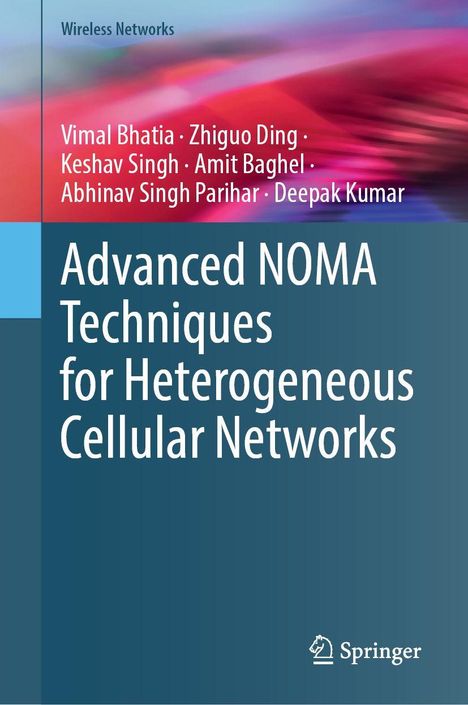
Vimal Bhatia: Advanced NOMA Techniques for Heterogeneous Cellular Networks, Gebunden
Advanced NOMA Techniques for Heterogeneous Cellular Networks
(soweit verfügbar beim Lieferanten)
- Verlag:
- Springer, 01/2026
- Einband:
- Gebunden
- Sprache:
- Englisch
- ISBN-13:
- 9783032095503
- Artikelnummer:
- 12463444
- Umfang:
- 172 Seiten
- Gewicht:
- 428 g
- Maße:
- 241 x 160 mm
- Stärke:
- 16 mm
- Erscheinungstermin:
- 3.1.2026
- Serie:
- Wireless Networks
- Hinweis
-
Achtung: Artikel ist nicht in deutscher Sprache!
Klappentext
This book provides a comprehensive exploration of Non-Orthogonal Multiple Access (NOMA) in Heterogeneous Cellular Networks (HCNs), focusing on both theoretical foundations and practical considerations. It examines critical challenges such as non-linear high-power amplifiers (HPAs), and imperfections in successive interference cancellation (SIC). Furthermore, it presents advanced techniques including simultaneous wireless information and power transfer (SWIPT) with cooperative NOMA and the application of reconfigurable intelligent surfaces (RIS) for enhancing coverage, reliability, and energy efficiency.
The authors also explore advanced research directions, including SWIPT-enabled cooperation, RIS-assisted performance analysis, and NOMA resilience under impairments suck as impulsive noise. Each chapter combines mathematical models, performance analysis, and design insights to provide a structured understanding of NOMA's role in enabling efficient and reliable communication in next-generation networks.
The primary audience for this book includes professionals in both industry and academia, who seek to apply advanced NOMA technologies to improve the performance and efficiency of HCN for 6G and beyond communication systems. As a secondary audience, graduate students in computer science, electronics and communications engineering, electrical engineering, and related disciplines will also gain both foundational knowledge and exposure to emerging research problems in this rapidly evolving field.