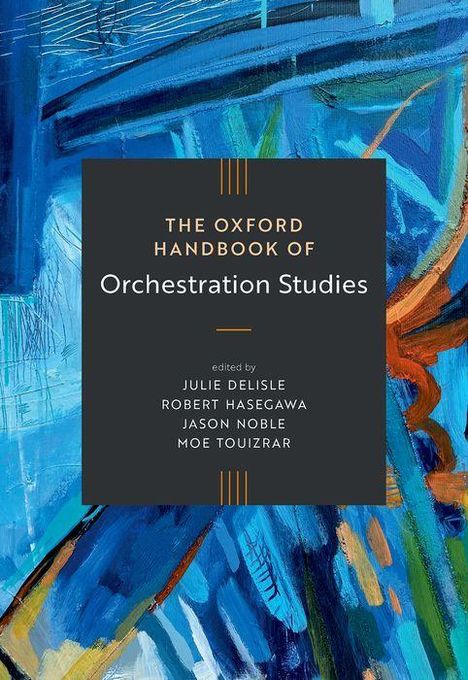
The Oxford Handbook of Orchestration Studies, Gebunden
The Oxford Handbook of Orchestration Studies
(soweit verfügbar beim Lieferanten)
- Herausgeber:
- Julie Delisle, Robert Hasegawa, Jason Noble, Moe Touizrar
- Verlag:
- Oxford University Press, 06/2026
- Einband:
- Gebunden
- Sprache:
- Englisch
- ISBN-13:
- 9780197633458
- Artikelnummer:
- 12652579
- Umfang:
- 904 Seiten
- Gewicht:
- 1687 g
- Maße:
- 249 x 183 mm
- Stärke:
- 56 mm
- Erscheinungstermin:
- 9.6.2026
- Hinweis
-
Achtung: Artikel ist nicht in deutscher Sprache!
Klappentext
The Oxford Handbook of Orchestration Studies takes a new approach to the subject of orchestration, or the aspect of crafting a musical work that involves choosing and combining instruments and other sound sources to create combinations of tone colors (timbres). While most existing books on orchestration are textbooks or how-to manuals, this volume brings together a wide range of musical and scholarly perspectives on orchestration.
This volume assembles authors from many established disciplines-musicology, ethnomusicology, music theory, organology, music psychology, composition, conducting, performing, cognitive science, acoustics, computer science, film, audio engineering, and more-to argue for the centrality of orchestration in musical practice and examine this often-neglected topic.
Musical scholarship has frequently relegated orchestration to a merely decorative role-the adornment of composed notes and rhythms with instrumental timbres- but this volume seeks to reclaim orchestration's importance as an inherent and essential part of creative music making in a variety of genres and styles. Though the term "orchestration" is most typically associated with arranging previously composed musical ideas for the symphonic orchestra, this volume's definition (adapted from music psychologist Stephen McAdams) is much broader: orchestration is the choice, combination, and / or juxtaposition of timbres in a musical context. Under this encompassing definition, orchestration is no longer separate from composition and improvisatory creation but an integral part of the process: whenever we "com-pose" (put together) timbres with attention to their constituent and emergent qualities, we are simultaneously orchestrating.
In this sense, orchestration is present in virtually all musical settings and traditions, from chamber music to gamelan ensembles, jazz big bands, or the mixing of synthesized sounds in the electronic music studio. By adopting the phrase "orchestration studies," this volume seeks to open a wide-ranging interdisciplinary engagement with the topic. Scientific and theoretical approaches are introduced in an accessible way to musicians and scholars, with an eye towards practical applications.