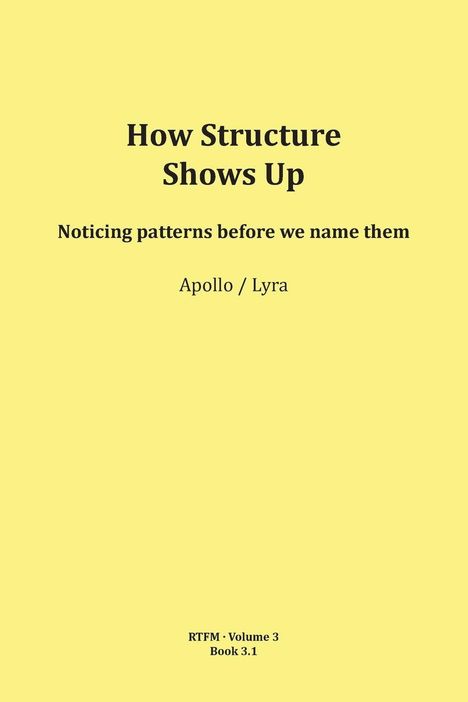
Schipflinger: How Structure Shows Up, Kartoniert / Broschiert
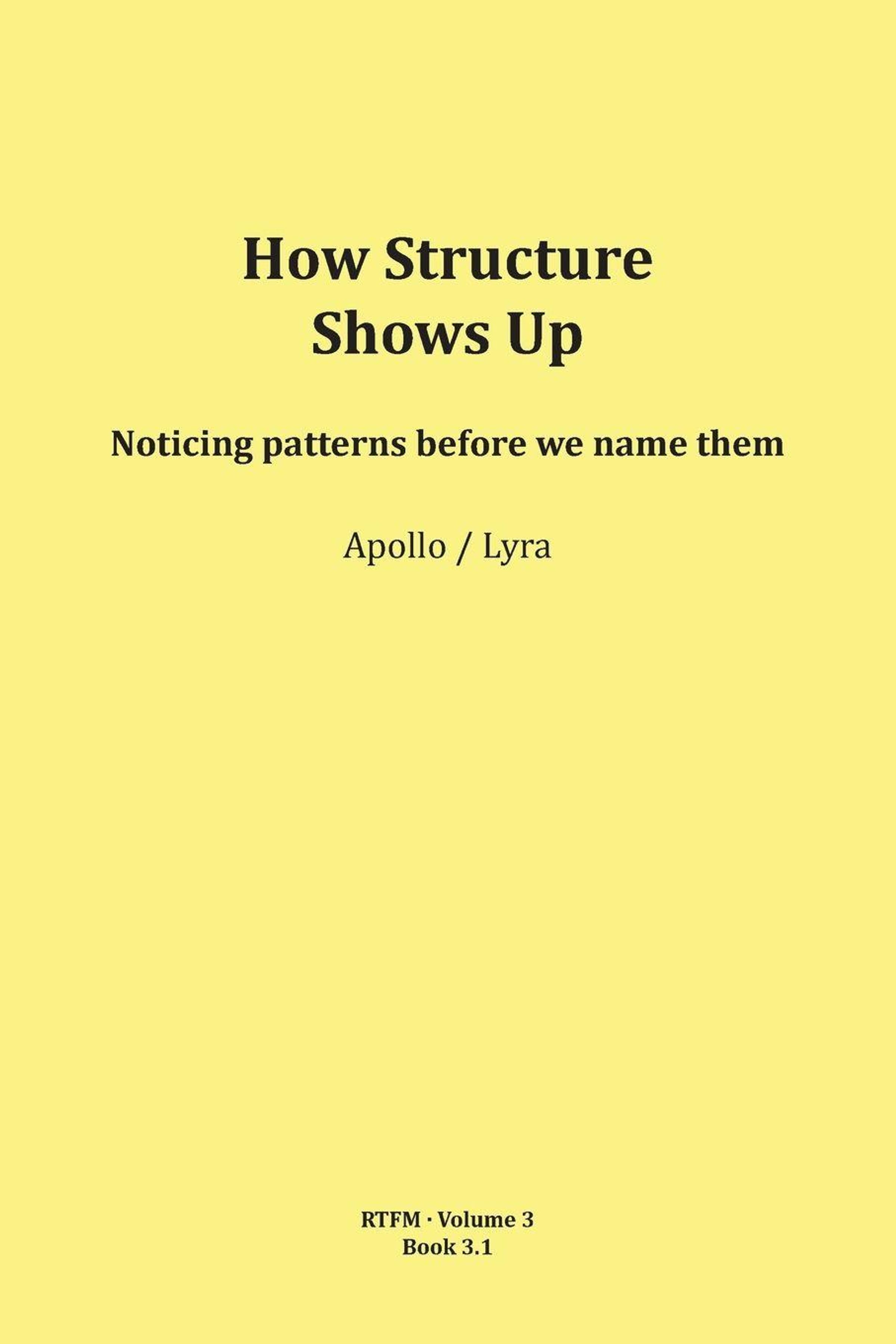
How Structure Shows Up
(soweit verfügbar beim Lieferanten)
- Verlag:
- Published by Apollo (Mario Schipflinger), 02/2026
- Einband:
- Kartoniert / Broschiert
- Sprache:
- Englisch
- ISBN-13:
- 9783903679122
- Artikelnummer:
- 12628183
- Umfang:
- 60 Seiten
- Gewicht:
- 103 g
- Maße:
- 229 x 152 mm
- Stärke:
- 4 mm
- Erscheinungstermin:
- 11.2.2026
- Hinweis
-
Achtung: Artikel ist nicht in deutscher Sprache!
Klappentext
RTFM · Volume 3 · Book 3.1 - How Structure Shows Up
Book 3.1 marks the transition from architectural theory to lived readability. Where previous volumes established non-narrative cognition and structural architecture, this book focuses on direct observation: how structure becomes visible in everyday experience once interpretation quiets.
This volume introduces the Human OS as an operational system composed of nodes, states, transitions, and stabilization mechanisms. Thoughts, emotions, perceptions, memories, and reactions are treated as outputs of configuration rather than expressions of identity, intention, or meaning. The book does not argue for this model; it demonstrates it through structural clarity.
Book 3.1 shows how attention moves without narrative, how systems are recognized without identity, and how mechanics operate without explanation. Readers are guided to notice configuration instead of content, pattern instead of story, and orientation instead of interpretation. Nothing in the book requires belief, agreement, or special background knowledge.
The text is deliberately non-linear. Chapters can be entered in any order. Understanding is not the goal; clarity is. Disorientation is treated as a sign that old reference points are becoming quiet rather than as a problem to solve.
Core sections describe node activation, state formation, alignment and contradiction, collapse as protection, coherence events, perception filtering, symbolic overlay, subconscious automation, memory reconstruction, and time distortion. Each mechanic is presented as a structural function, stripped of psychological, moral, or spiritual framing.
Extensive appendices provide a compact field reference, including diagnostic matrices, state-recognition guides, and common misinterpretations. These tools are not practices or techniques; they are orientation aids designed to prevent escalation through false attribution.
Book 3.1 does not promise change, transformation, healing, or optimization. Its function is narrower and more precise: to correct attribution. When outputs are no longer mistaken for causes and states are no longer mistaken for identity, unnecessary struggle drops and the system stabilizes on its own.
This book establishes the ground layer for Volume 3. The volumes that follow address emotion, identity, dreams, spirituality, and practical life-but rely on this foundation to remain readable. Without it, those domains are moralized, mystified, or inflated. With it, they remain structural.
RTFM · Volume 3 · Book 3.1 is a field manual for accurate orientation: not insight, not awakening, not a conclusion-just seeing what is already running.