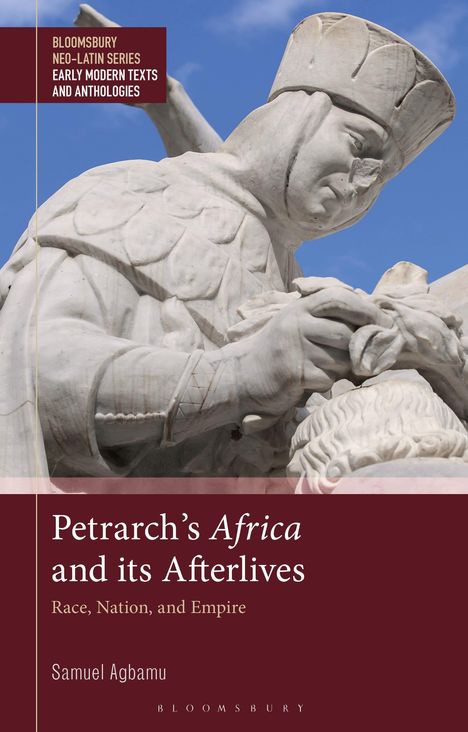
Samuel Agbamu: Petrarch's Africa and Its Afterlives, Gebunden
Petrarch's Africa and Its Afterlives
- Race, Nation, and Empire
(soweit verfügbar beim Lieferanten)
- Verlag:
- Bloomsbury Academic, 05/2026
- Einband:
- Gebunden
- Sprache:
- Englisch
- ISBN-13:
- 9781350330795
- Artikelnummer:
- 12590534
- Umfang:
- 222 Seiten
- Gewicht:
- 454 g
- Maße:
- 234 x 156 mm
- Stärke:
- 25 mm
- Erscheinungstermin:
- 14.5.2026
- Serie:
- Bloomsbury Neo-Latin Series: Studies in Early Modern Latin
- Hinweis
-
Achtung: Artikel ist nicht in deutscher Sprache!
Klappentext
This open access monograph sheds new light on the epic by focusing on its importance as a vector for ideas about Africa and Africans between the 14th and 20th centuries. In Italy and abroad, the 14th-century poet Petrarch's Italian verse has secured his place in literary history. Yet his greatest triumph was to be crowned in Rome in 1341, ostensibly for his then incomplete Latin epic of the Second Punic War, the Africa. However, soon after the poem's posthumous publication, the Africa fell into relative obscurity. The afterlives of the epic remain largely unexplored, particularly with regard to Petrarch's representation of the Second Punic War and the continent on which Scipio Africanus defeated Hannibal: Africa.
The book also explores the contribution of the Africa to early modern and modern discourses of religion, nation and empire. Samuel Agbamu uncovers the role of the Africain the intellectual archaeologies of nation, empire and race in the modern era and its role as a vector in the transmission and transformation of Roman ideas of empire and identity as reflected in accounts of the Punic War. This monograph makes its case through fresh close readings of the Africa, using new methodologies based on Premodern Critical Race Studies and Critical Muslim Studies.
The eBook editions of this book are available open access under a CC BY-NC-ND 4.0 licence on bloomsburycollections. com. Open access was funded by the University of Reading.