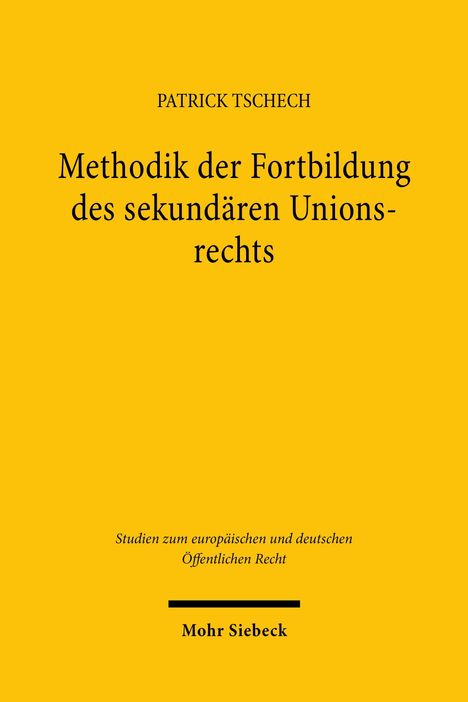
Patrick Tschech: Methodik der Fortbildung des sekundären Unionsrechts, Kartoniert / Broschiert
Methodik der Fortbildung des sekundären Unionsrechts
- Eine Untersuchung auf Grundlage der Funktion des EuGH im Prozess der Rechtserzeugung und Rechtsverwirklichung
Sie können den Titel schon jetzt bestellen. Versand an Sie erfolgt gleich nach Verfügbarkeit.
- Verlag:
- Mohr Siebeck GmbH & Co. K, 11/2026
- Einband:
- Kartoniert / Broschiert
- Sprache:
- Deutsch
- ISBN-13:
- 9783162006622
- Artikelnummer:
- 12845552
- Umfang:
- 450 Seiten
- Nummer der Auflage:
- 26001
- Ausgabe:
- 1. Auflage
- Erscheinungstermin:
- 30.11.2026
- Serie:
- Studien zum europäischen und deutschen Öffentlichen Recht
Klappentext
Patrick Tschech develops a methodology for the advancement of EU secondary law based on a consistent integration of legal theory, linguistic theory, and European law doctrine. To this end, he first designs-drawing on the Pure Theory of Law-a theoretical model that describes the process of law-making and law realization within a specific legal order. On this basis, he analyses the EU legal order and defines the role of the Court of Justice of the European Union in relation to other branches of power.
To reflect this functional distribution, it is also useful in the context of secondary law to apply the distinction, familiar in German legal methodology, between interpretation and legal development. However, for reasons related to linguistic theory, this distinction cannot be based on the possible literal meaning. Instead, Tschech proposes a separate criterion aligned with the Court's function and explains why interpretation and legal development are in fact distinct methods rather than merely different stages within a single process of legal reasoning.
Building on this, he develops a theory of legal gaps that enables the Court to fulfil its role in ensuring the coherence of EU law without unilaterally extending its scope of regulation at the expense of the Member States.
Anmerkungen:
Bitte beachten Sie, dass auch wir der Preisbindung unterliegen und kurzfristige Preiserhöhungen oder -senkungen an Sie weitergeben müssen.