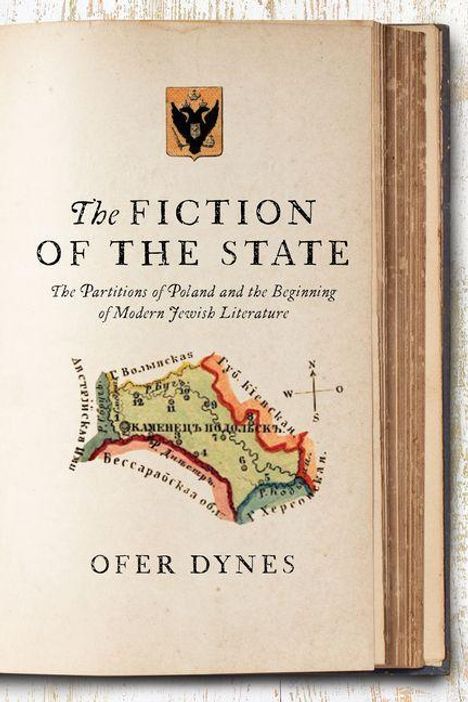
Ofer Dynes: The Fiction of the State, Gebunden
The Fiction of the State
- The Partitions of Poland and the Beginning of Modern Jewish Literature
Sie können den Titel schon jetzt bestellen. Versand an Sie erfolgt gleich nach Verfügbarkeit.
- Verlag:
- Stanford University Press, 09/2026
- Einband:
- Gebunden
- Sprache:
- Englisch
- ISBN-13:
- 9781503647435
- Artikelnummer:
- 12644962
- Umfang:
- 228 Seiten
- Gewicht:
- 472 g
- Maße:
- 229 x 152 mm
- Stärke:
- 20 mm
- Erscheinungstermin:
- 15.9.2026
- Hinweis
-
Achtung: Artikel ist nicht in deutscher Sprache!
Weitere Ausgaben von The Fiction of the State |
Preis |
|---|---|
| Buch, Kartoniert / Broschiert, Englisch | EUR 39,15* |
Klappentext
In a compelling new interpretation, this book locates the origins of modern Jewish literature within the turbulent events which reshaped Europe during the late eighteenth century: the partitions of Poland, the French Revolution, and the Napoleonic Wars. As Austria, Russia, and Prussia consolidated their rule over the Polish lands and banned most forms of political expression, literature became a central venue for reflecting on the new political order. Ofer Dynes argues that Jewish intellectuals turned to fiction -- prose, poetry, and drama -- to engage in political debates and make sense of new state structures. Through their writing, Jewish intellectuals positioned themselves as interpreters, mediators, and, at times, collaborators with the new imperial powers.
Combining meticulous archival research and nuanced textual readings, Dynes contextualizes modern Jewish literature as rooted in the awareness of major political upheaval. Rather than an internal Jewish struggle between tradition and modernity, he presents Hebrew and Yiddish literature as a field of negotiation among multiple local and imperial belongings. Radically expanding the literary canon, he uncovers a diverse and often unexpected array of figures and texts, including a Catholic Austrian bureaucrat who wrote poetry in Yiddish, a Prussian rabbi and French count who jointly composed a poem to the Russian Tsar; and a Hebrew novel born out of its author's collaboration with the secret police. Connecting Jewish texts with broader trends in European history, this book presents an untold story of how Jewish writers used literature to grapple with a shifting political landscape in the age of Enlightenment and empires.