Neil Tennant: Logic. The Sequel, Kartoniert / Broschiert
Logic. The Sequel
(soweit verfügbar beim Lieferanten)
- Verlag:
- College Publications, 09/2026
- Einband:
- Kartoniert / Broschiert
- Sprache:
- Englisch
- ISBN-13:
- 9781848905207
- Artikelnummer:
- 12922868
- Umfang:
- 476 Seiten
- Gewicht:
- 717 g
- Maße:
- 234 x 156 mm
- Stärke:
- 25 mm
- Erscheinungstermin:
- 3.9.2026
- Hinweis
-
Achtung: Artikel ist nicht in deutscher Sprache!
Klappentext
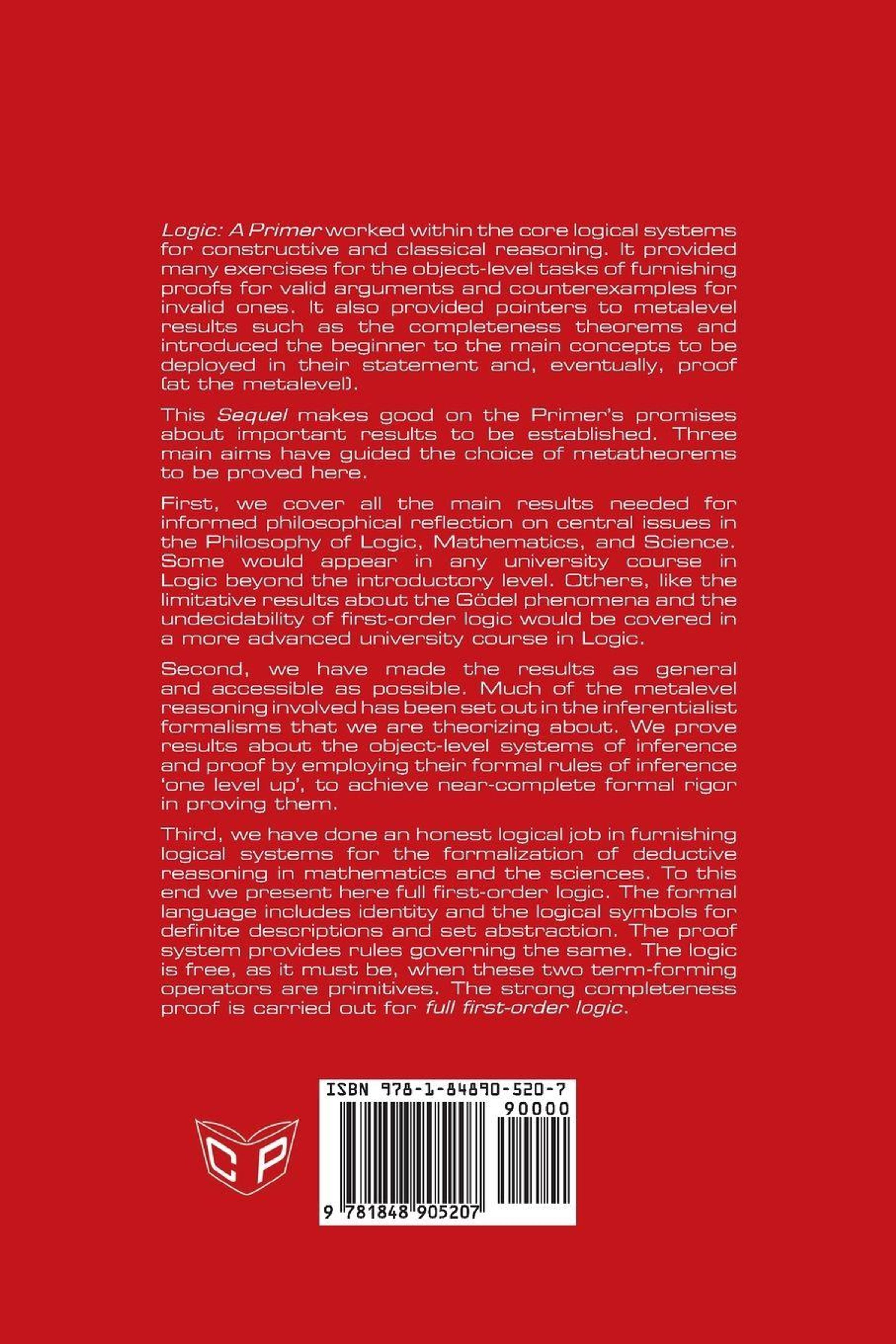
Logic: A Primer worked within the core logical systems for constructive and classical reasoning. It provided many exercises for the object-level tasks of furnishing proofs for valid arguments and counterexamples for invalid ones. It also provided pointers to metalevel results such as the completeness theorems and introduced the beginner to the main concepts to be deployed in their statement and, eventually, proof (at the metalevel).
This Sequel makes good on the Primer's promises about important results to be established. Three main aims have guided the choice of metatheorems to be proved here. First, we cover all the main results needed for informed philosophical reflection on central issues in the Philosophy of Logic, Mathematics, and Science. Some would appear in any university course in Logic beyond the introductory level. Others, like the limitative results about the Gödel phenomena and the undecidability of first-order logic would be covered in a more advanced university course in Logic.
Second, we have made the results as general and accessible as possible. Much of the metalevel reasoning involved has been set out in the inferentialist formalisms that we are theorizing about. We prove results about the object-level systems of inference and proof by employing their formal rules of inference 'one level up', to achieve near-complete formal rigor in proving them.
Third, we have done an honest logical job in furnishing logical systems for the formalization of deductive reasoning in mathematics and the sciences. To this end we present here full first-order logic. The formal language includes identity and the logical symbols for definite descriptions and set abstraction. The proof system provides rules governing the same. The logic is free, as it must be, when these two term-forming operators are primitives. The strong completeness proof is carried out for full first-order logic.