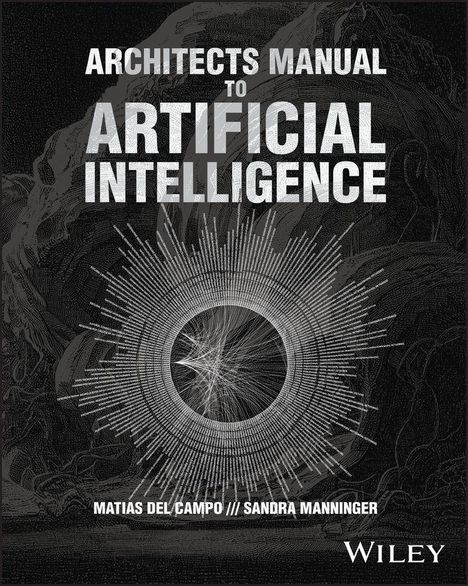
Matias Del Campo: Architects Manual to Artificial Intelligence, Kartoniert / Broschiert
Architects Manual to Artificial Intelligence
Sie können den Titel schon jetzt bestellen. Versand an Sie erfolgt gleich nach Verfügbarkeit.
- Verlag:
- John Wiley & Sons Inc, 12/2026
- Einband:
- Kartoniert / Broschiert
- Sprache:
- Englisch
- ISBN-13:
- 9781394414963
- Artikelnummer:
- 12861788
- Umfang:
- 528 Seiten
- Erscheinungstermin:
- 7.12.2026
- Hinweis
-
Achtung: Artikel ist nicht in deutscher Sprache!
Klappentext
Architecture-specific AI reference combining executable Python code with critical theory
Architects and computational designers lack a single resource that integrates AI theory, critical discourse, and working code within an architectural context. The Architects Manual to Artificial Intelligence, written by the co-founders of SPAN, addresses this directly. Covering CNNs, GANs, transformers, diffusion models, and more, the book provides both the conceptual frameworks and executable Python scripts needed to deploy AI in design practice.
The manual introduces a distinctive pedagogical system: Grey Boxes catalog architectural applications for specific AI models, while Black Boxes supply executable Python code for tasks such as generating structural details with Pix2Pix, creating 3D terrain with 3DGAN, and optimizing spatial layouts with TransformerGAN. Original frameworks including Vibe Coding, Concatenation, and the AI Iceberg structure the theoretical discourse.
The book also covers:
- Proprietary datasets including the Baroque Plan Dataset of over 2, 000 annotated plans used in real project workflows
- Detailed analysis of GraphCNN, TransformerGAN, Gaussian Splatting, CycleGAN, and other architectures beyond standard image-generator discourse
- Real-world project breakdowns from SPAN including the Deep House using StyleGAN2 and the Robot Garden workflow
- A dual-channel structure enabling simultaneous use as a technical coding workshop and a critical design seminar
- Examination of how AI reorganizes authorship, form-making, material reasoning, and architectural representation across the built environment
Designed for advanced architecture students, computational design researchers, practicing architects in technology-forward firms, and studio instructors integrating AI into curricula, this manual occupies the underserved middle ground between purely theoretical texts and general computer science references lacking architectural context.