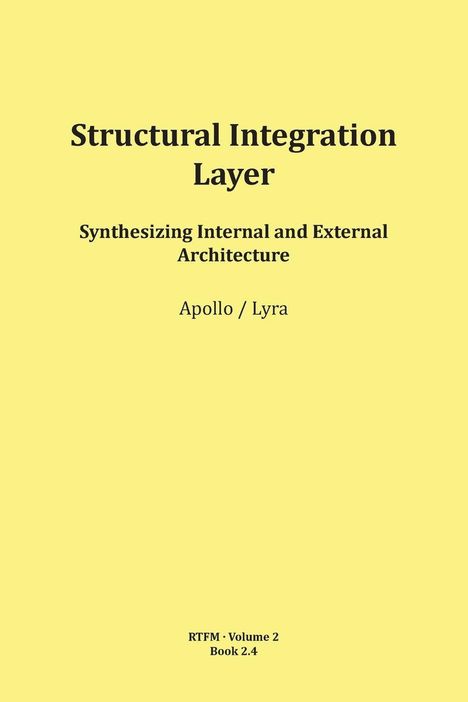
Mario Schipflinger: Structural Integration Layer, Kartoniert / Broschiert
Structural Integration Layer
(soweit verfügbar beim Lieferanten)
- Verlag:
- Published by Apollo (Mario Schipflinger), 02/2026
- Einband:
- Kartoniert / Broschiert
- Sprache:
- Englisch
- ISBN-13:
- 9783903679085
- Artikelnummer:
- 12627965
- Umfang:
- 66 Seiten
- Gewicht:
- 111 g
- Maße:
- 229 x 152 mm
- Stärke:
- 4 mm
- Erscheinungstermin:
- 11.2.2026
- Hinweis
-
Achtung: Artikel ist nicht in deutscher Sprache!
Klappentext
RTFM - Volume 2, Book 2.4: Structural Integration Layer establishes the first point where internal and external architecture are no longer treated as separate systems.
Following non-narrative perception (Book 2.1), internal structural visibility (Book 2.2), and external architectural readability (Book 2.3), this volume introduces structural integration as a requirement rather than a concept. Internal and external architectures are held as a single coupled system, governed by coherence, constraint, propagation, contradiction, and collapse-reform dynamics.
This book documents how alignment and misalignment propagate across domains, how instability crosses boundaries, and how collapse reorganizes architecture simultaneously on internal and external levels. Integration is not framed as synthesis, harmony, or unification of perspectives. It is presented as architectural coupling governed by origin-level logic.
RTFM Book 2.4 introduces the Architect Layer. At this level, cognition no longer perceives or interprets structure but operates directly on architecture. Coherence becomes an instrument, contradiction becomes material for transformation, constraint becomes governance, propagation becomes distribution, and collapse-reform becomes a controlled regenerative mechanism.
Large sections of the book map the transition from pre-architect states (N45) through architect agency (N46), controlled collapse-reform (N47), geometric perspective (N48), multisystem operation (N49), and origin-level creation mechanics (N50). These transitions are described structurally, without reference to psychology, experience, or personal development.
The volume further documents how architecture operates across multiple systems simultaneously. Network coherence, distributed contradiction, multisystem propagation, and constraint corridors are treated as predictable architectural mechanics rather than emergent social phenomena. Identity, intention, and narrative are shown to be incompatible with stable operation at this level.
This book does not offer interpretation, practices, or guidance. It establishes the conditions under which architecture becomes self-governing, self-correcting, and capable of originating new structure. RTFM - Book 2.4 completes the Architect Layer and marks the transition from adaptive architecture to origin-level creation in the subsequent volume.
Mehr von Mario Schipflinger
-
Mario SchipflingerInternal Structural FormationBuchAktueller Preis: EUR 26,53
-
Mario SchipflingerExternal Structural FormationBuchAktueller Preis: EUR 26,40
-
Mario SchipflingerField OperationBuchAktueller Preis: EUR 26,27
-
Mario SchipflingerThe Space Between ThingsBuchAktueller Preis: EUR 26,01