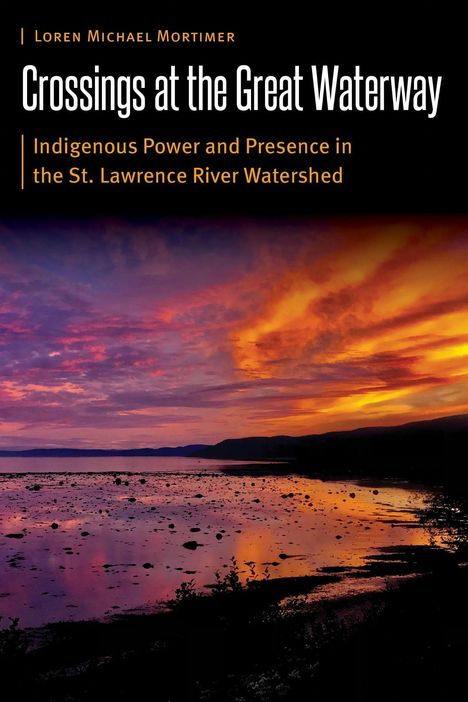
Loren Michael Mortimer: Crossings at the Great Waterway, Gebunden
Crossings at the Great Waterway
- Indigenous Power and Presence in the St. Lawrence River Watershed
Sie können den Titel schon jetzt bestellen. Versand an Sie erfolgt gleich nach Verfügbarkeit.
- Verlag:
- University of Nebraska Press, 02/2027
- Einband:
- Gebunden
- Sprache:
- Englisch
- ISBN-13:
- 9781496234087
- Artikelnummer:
- 12623491
- Umfang:
- 322 Seiten
- Erscheinungstermin:
- 1.2.2027
- Serie:
- Borderlands and Transcultural Studies
- Hinweis
-
Achtung: Artikel ist nicht in deutscher Sprache!
Klappentext
Crossings at the Great Waterway recovers the deep, continuous history of the St. Lawrence River as an Indigenous place-world of diplomacy, ecology, and endurance. Spanning from the retreat of the glaciers to the industrial age, it reinterprets the river known in Mohawk as Kaniatarowanenneh, "the Great Waterway," as the center of a sovereign Indigenous world sustained by the confederation of the Seven Nations of Canada. Drawing from archival, archaeological, and ecological evidence, Loren Michael Mortimer reveals how Native peoples transformed a contested colonial corridor into a continuous space of self-determined Indigenous governance and environmental stewardship.
Mortimer traces critical moments when the Seven Nations leveraged kinship, mobility, and ecological knowledge to navigate climate upheavals, imperial wars, and shifting borders from the sixteenth through nineteenth centuries. Figures such as Colonel Louis (Akiatonharónkwen), Akwesasne women leaders, and Catholic diplomats embody a political tradition grounded in place-based autonomy rather than subjugation to empire.
Integrating political ecology and Indigenous governance, Crossings at the Great Waterway reframes the history of northeastern North America through an Indigenous hydrography that transcends national boundaries. This first comprehensive and transnational study of Indigenous peoples in the St. Lawrence Valley upends familiar colonialist narratives that placed these communities on the margins of U. S. and Canadian national history. Mortimer demonstrates how the waters of Kaniatarowanenneh sustained an evolving confederation that continues to define the legal, ecological, and political landscapes of the U. S.-Canada borderlands today.