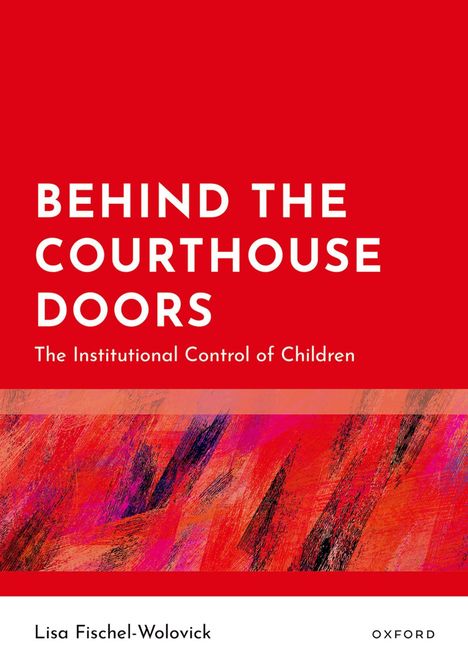
Lisa Fischel-Wolovick: Behind the Courthouse Doors, Gebunden
Behind the Courthouse Doors
- The Institutional Control of Children
Sie können den Titel schon jetzt bestellen. Versand an Sie erfolgt gleich nach Verfügbarkeit.
- Verlag:
- Oxford University Press, 09/2026
- Einband:
- Gebunden
- Sprache:
- Englisch
- ISBN-13:
- 9780197681190
- Artikelnummer:
- 12673987
- Umfang:
- 320 Seiten
- Erscheinungstermin:
- 14.9.2026
- Hinweis
-
Achtung: Artikel ist nicht in deutscher Sprache!
Klappentext
Behind the Courthouse Doorsaddresses the historical development of the juvenile, and its successor, the family courts, expanding the concept of coercive control to include institutional coercive control. These courts were intended to be a progressive reform effort to provide humane treatment for children, separating them from adults accused of crimes. In the early twentieth century, the first juvenile courts were intended to be informal, private judicial forums. In these courts, one experienced judge was to address all the problems experienced by families, as the head of an interdisciplinary team. Rather than using traditional litigation to resolve these legal problems, judges were to provide therapeutic justice to solve the family's underlying problems. From their inception, these courts lacked sufficient funds and training needed to address the complex problems of vulnerable families. This book addresses the research on the historical development of the juvenile and family courts, and related child protection and juvenile delinquency systems. The failure of the U. S. to ratify international treaties that govern the treatment of children has impacted the care of children in the immigration courts as well. During immigration proceedings, the problem is particularly acute for children who have no guaranteed right to court-appointed attorneys and are at risk of detention and deportation. All of these institutions exercise control over children. Without transparency through court monitoring, a documented process to learn from the tragedy of each child fatality, effective judicial training, and the use of evidence-based trials, unfettered institutional control becomes coercive.