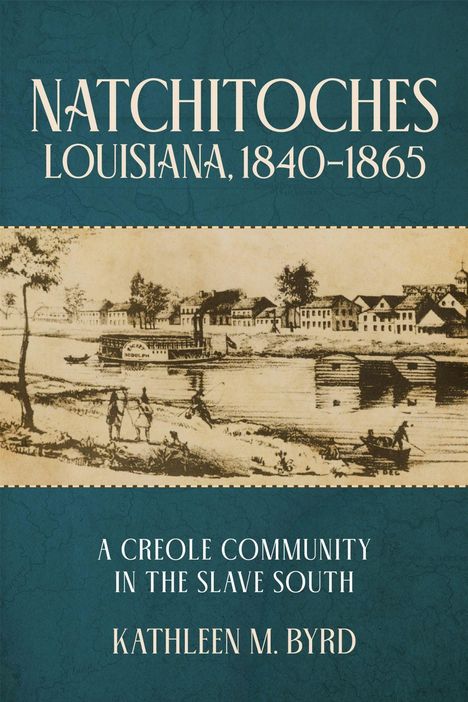
Kathleen M Byrd: Natchitoches, Louisiana, 1840-1865, Kartoniert / Broschiert
Natchitoches, Louisiana, 1840-1865
- A Creole Community in the Slave South
Sie können den Titel schon jetzt bestellen. Versand an Sie erfolgt gleich nach Verfügbarkeit.
- Verlag:
- LSU Press, 11/2026
- Einband:
- Kartoniert / Broschiert
- Sprache:
- Englisch
- ISBN-13:
- 9780807186596
- Artikelnummer:
- 12688575
- Umfang:
- 360 Seiten
- Gewicht:
- 463 g
- Maße:
- 229 x 152 mm
- Stärke:
- 20 mm
- Erscheinungstermin:
- 9.11.2026
- Hinweis
-
Achtung: Artikel ist nicht in deutscher Sprache!
Klappentext
This book is the sequel to Kathleen M. Byrd's 2024 study, Natchitoches, Louisiana, 1803--1840: A Creole Community on the American Frontier . Picking up the story in the 1840s and taking it through the Civil War, Byrd shows in this volume the economic activities of not only the planters and their enslaved workers but also the upland farmers, tradesmen, merchants, and others during the 1840s and 1850s. She then discusses how the disastrous Civil War created challenges for all those living on the home front.
Using the Phanor Prudhomme plantation, located down Cane River from the town of Natchitoches, as a case study, Byrd provides a portrait of life on a Louisiana cotton farm in the years just before the Civil War. Although cotton was the primary cash crop in Natchitoches during this period, most residents were not part of a planter household. Many farmers adopted other strategies, such as mixed-crop farming and herding, to sustain their families. Some small farmers were slaveholders; most were not. They were nonetheless complicit in maintaining slavery, either through renting enslaved people or by striving to become slaveholders themselves.
Byrd shows that the town of Natchitoches served as the economic and social center of the area, a place where larger merchants had stores, wealthy planters had townhouses, and the Catholic diocese had its cathedral and seminary. It was the parish seat with a courthouse, lawyers, and associated government officials, as well as doctors, druggists, and hotel keepers. The town had a newspaper and a racetrack, where the Natchitoches Jockey Club held its annual races.
White residents of Natchitoches were well informed about national developments. After the 1860 presidential election, most men in town voted against immediate secession, but they changed their stance when the Civil War began. Their enthusiasm for the Confederacy ebbed, however, as the war dragged on. The war reached Natchitoches Parish when the Union army invaded the Red River Valley and occupied Natchitoches. Foraging activities by both Union and Confederate soldiers left the town and countryside devastated, while enslaved laborers used the chaos of war to seek freedom.