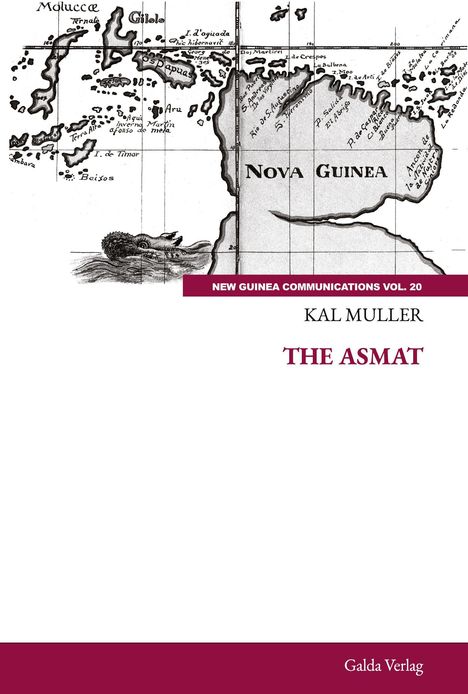
Kal Muller: The Asmat, Kartoniert / Broschiert
The Asmat
(soweit verfügbar beim Lieferanten)
- Verlag:
- Galda Verlag, 12/2025
- Einband:
- Kartoniert / Broschiert
- Sprache:
- Englisch
- ISBN-13:
- 9783962034672
- Artikelnummer:
- 12566532
- Umfang:
- 182 Seiten
- Nummer der Auflage:
- 25001
- Ausgabe:
- 1. Auflage
- Gewicht:
- 312 g
- Maße:
- 230 x 155 mm
- Stärke:
- 12 mm
- Erscheinungstermin:
- 3.12.2025
- Serie:
- New Guinea Communications, Volume 20
- Hinweis
-
Achtung: Artikel ist nicht in deutscher Sprache!
Klappentext
The Asmat ethnolinguistic group was the last major culture in Indonesia to bow to outside influences. Traditionally, it was a culture that prized headhunting and widely practiced cannibalism. Today, the Asmat number some 110, 000 people, considerably more than during the days of unrestricted warfare. They live in some 18, 000 km2 of land on the south shore of West New Guinea (or West Papua) in what is now Indonesia. Their homeland consists of mangroves, tidal swamps, freshwater swamps, and lowland rainforest. They live along the north shore of the Arafura Sea and a considerable distance inland, aways next to rivers. Their dwellings are on piles due to the high tides that reach far in the flat inland. The outside world was quickly attracted to the Asmat's unique carvings. These consist of elaborate large wood carvings such as 'bisj' poles, designed to honor their ancestors. The many other art forms include elaborate shields, finely sculpted hourglass drums and large canoe prows often featuring the praying mantis, the headhunter symbol par excellence. Traditionally, the Asmat men were completely naked in all their activities, including warfare and carving. Many Asmat artifacts have been collected by the world's museums, among the most notable of which are those found in the Michael C. Rockefeller Collection at the Metropolitan Museum of Art in New York City and the Tropenmuseum in Amsterdam. Asmat art is widely displayed in major Western museums. Despite the difficulty in visiting the remote region to collect work, the "exceptionally expressive" art "caused a sensation in art-collecting circles" which led to large-scale collecting expeditions in the post-WW II era. In this book we cover the Asmat in nine chapters with a strong emphasis on their artistic carvings. A chapter is devoted to the diary of Michael Rockefeller who disappeared while collecting art in the Asmat area.
Anmerkungen:
Bitte beachten Sie, dass auch wir der Preisbindung unterliegen und kurzfristige Preiserhöhungen oder -senkungen an Sie weitergeben müssen.