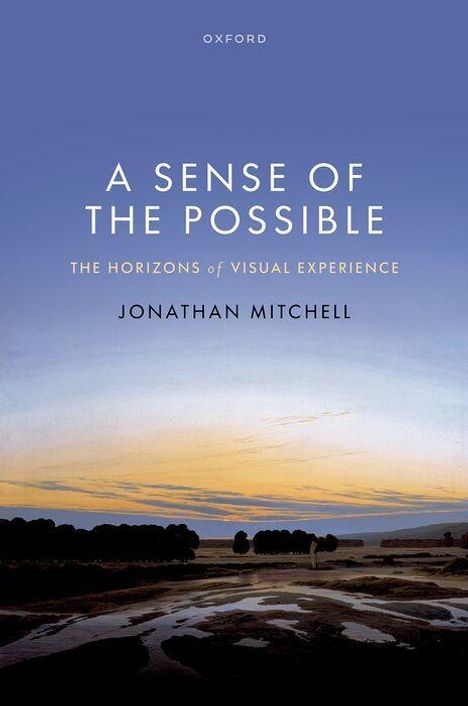
Jonathan Mitchell: A Sense of the Possible, Gebunden
A Sense of the Possible
- The Horizons of Visual Experience
Sie können den Titel schon jetzt bestellen. Versand an Sie erfolgt gleich nach Verfügbarkeit.
- Verlag:
- Oxford University Press, 10/2026
- Einband:
- Gebunden
- Sprache:
- Englisch
- ISBN-13:
- 9780198999003
- Artikelnummer:
- 12708268
- Umfang:
- 240 Seiten
- Gewicht:
- 517 g
- Maße:
- 240 x 167 mm
- Stärke:
- 20 mm
- Erscheinungstermin:
- 7.10.2026
- Hinweis
-
Achtung: Artikel ist nicht in deutscher Sprache!
Klappentext
This book tackles a long-standing puzzle concerning visual experiences. How is it the case that we can enjoy visual experiences as of complete three-dimensional entities given the fact that we are limited to seeing the side or sides facing us from a specific spatial perspective. How are these phenomenological facts to be reconciled? The contention of this study is that we can solve this puzzle, and in so doing make sense of a foundational form of spatial perception, through a correct understanding of the role that a 'sense of the possible' plays in perception. More specifically, the central idea is that visual experiences include an implicit element which 'refers beyond' what is explicitly given of the object, to parts of it which are currently occluded or out of view, thus making up for our perspectivally limited viewpoint such as to provide us with an experience as of a complete thing. The work begins by turning to the work of Edmund Husserl. More than any other philosopher Husserl should be credited with putting this puzzle and the issues surrounding it at the centre stage of an understanding of visual experience. Indeed, he has a distinctive term for the component of intentional experiences that 'refer beyond', namely an intentional horizon. Following an initial reconstruction of the notion of an intentional horizon, the majority of the book is given over to a systematic exploration of the character and role of intentional horizons in visual experiences as of three-dimensional objects, such that it seeks to answer just what is required to see such objects as being complete three-dimensional things. In doing so, the book critically evaluates a range of proposals and then proposes its own original Modal-Ability view.