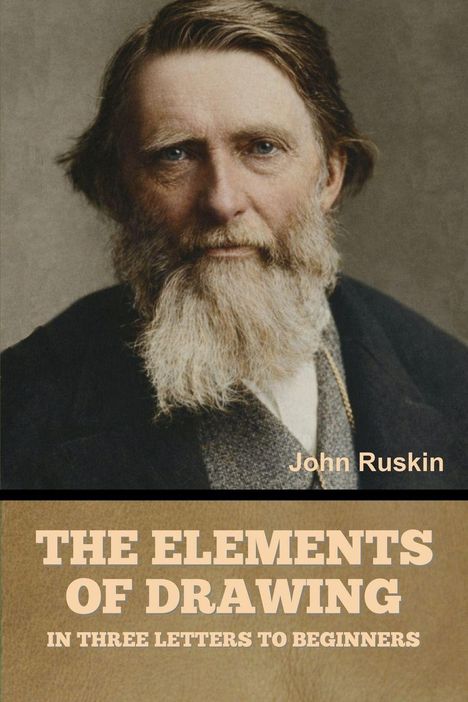
John Ruskin: The Elements of Drawing, in Three Letters to Beginners, Kartoniert / Broschiert
The Elements of Drawing, in Three Letters to Beginners
(soweit verfügbar beim Lieferanten)
- Verlag:
- IndoEuropeanPublishing.com, 02/2026
- Einband:
- Kartoniert / Broschiert
- Sprache:
- Englisch
- ISBN-13:
- 9798889425823
- Artikelnummer:
- 12633837
- Umfang:
- 144 Seiten
- Gewicht:
- 245 g
- Maße:
- 229 x 152 mm
- Stärke:
- 9 mm
- Erscheinungstermin:
- 21.2.2026
- Hinweis
-
Achtung: Artikel ist nicht in deutscher Sprache!
Klappentext
The Elements of Drawing by John Ruskin is a foundational art instruction manual written as a series of letters to aspiring artists. First published in 1857, the book is structured in three parts, each addressing different stages of a beginner's artistic development. Ruskin emphasizes careful observation as the core of drawing, arguing that true artistic skill begins not with technique alone but with learning how to see accurately. He encourages students to study nature closely, to notice subtle variations in light, shadow, and form, and to draw with patience and discipline rather than rushing toward stylistic expression.
In the first letter, Ruskin focuses on the importance of perceiving and representing tone. He teaches beginners to understand light and shade before attempting complex subjects, guiding them through exercises that build control and sensitivity. The second letter moves toward color and composition, stressing that artists must remain faithful to nature rather than rely on imagination or convention. Ruskin believes that drawing is a moral as well as technical practice; honesty in observation reflects honesty of character. The final letter addresses landscape drawing and the emotional response to nature, encouraging students to capture not just physical detail but also the spirit and atmosphere of a scene.
Throughout the book, Ruskin's tone is both instructive and philosophical. He rejects mechanical copying and instead promotes thoughtful engagement with the natural world. His approach reflects his broader belief that art is deeply connected to truth, beauty, and moral integrity. By presenting his lessons in the form of personal letters, Ruskin creates an intimate and encouraging guide for beginners, making The Elements of Drawing not only a technical manual but also a meditation on the purpose and value of art.
About the Author
John Ruskin (1819-1900) was a leading English art critic, writer, and social thinker of the Victorian era. Born in London to a prosperous wine merchant, Ruskin was educated privately and later attended the University of Oxford. From an early age he showed a deep appreciation for art and nature, interests that would shape his life's work. His eloquent prose and passionate beliefs made him one of the most influential cultural figures of the nineteenth century.
Ruskin first gained widespread recognition with the publication of Modern Painters (1843-1860), a multi-volume work in which he defended the painter J. M.W. Turner and argued that artists should remain faithful to nature. He believed that art should express truth and moral purpose rather than merely imitate classical traditions. His ideas challenged established academic standards and helped elevate landscape painting to greater prominence in Britain. Ruskin's criticism combined detailed observation with broader reflections on beauty, imagination, and spirituality.
Beyond art criticism, Ruskin became an outspoken social critic. In works such as Unto This Last (1860) and Sesame and Lilies (1865), he attacked industrial capitalism and argued that economic systems should prioritize human well-being over profit. He was deeply troubled by the social inequalities and environmental damage brought about by industrialization. His social philosophy influenced later reformers, including Mahatma Gandhi, and contributed to movements advocating for social justice and improved working conditions. ...