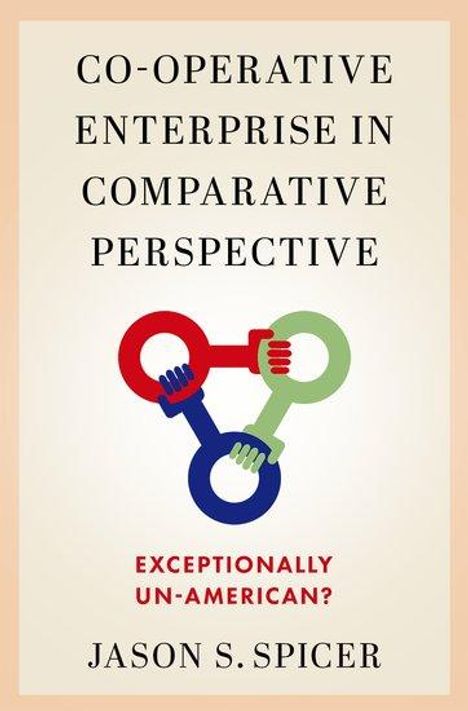
Jason S Spicer: Co-Operative Enterprise in Comparative Perspective, Gebunden
Co-Operative Enterprise in Comparative Perspective
- Exceptionally Un-American?
Lassen Sie sich über unseren eCourier benachrichtigen, sobald das Produkt bestellt werden kann.
- Verlag:
- Oxford University Press, 01/2030
- Einband:
- Gebunden
- Sprache:
- Englisch
- ISBN-13:
- 9780197665077
- Umfang:
- 326 Seiten
- Gewicht:
- 594 g
- Maße:
- 242 x 164 mm
- Stärke:
- 26 mm
- Erscheinungstermin:
- 1.1.2030
- Hinweis
-
Achtung: Artikel ist nicht in deutscher Sprache!
Ähnliche Artikel


Klappentext
Co-operative enterprises, which are democratically owned and governed by their workers, customers, or suppliers, have long captured the imagination of activists and social scientists alike. In centering economic democracy and a collectivist-democratic logic, and in embodying a "third way" alternative to profit-maximizing corporations and state-owned enterprises, co-operatives offer the promise of a more sustainable and equitable economy.
Despite extensive study of co-operatives' real and imagined benefits, we know little about the conditions under which they achieve the lasting scale needed to be a viable alternative and transform the economy. Under what conditions can co-operatives achieve such scale? And are such conditions present in the United States, where, despite repeated organizing efforts, co-operatives remain exceptionally rare at scale?
Through a rigorous comparative-historical analysis of co-operative enterprises in different national contexts, this book seeks to answer these questions. Deploying two different variants of the new institutionalism, Spicer treats the United States as a central case of comparative failure, as contrasted to three rich democracies where the co-operative business model has been more successful: Finland, France, and New Zealand.
The cause of co-operatives' comparative weakness in the United States is identified as reflecting the joint effect of economic liberalism and structural racism. Only in the United States did the co-operative face, in its initial development, two well-entrenched incumbents operating with competing ownership models: the investor-owned firm and the race-based chattel slavery system of ownership of people. Proponents of these two models acted to deprive the co-operative movement of resources, and undermined the solidarity at the co-operative business model's heart, splintering the American co-operative movement in the process. In subsequent waves of co-operative organizing, advocates have never fully succeeded in overcoming these initial obstacles, resulting in a different outcome in the United States, consistent with broader conceptions of the United States as a perennial outlier (i. e., ""American exceptionalism""). In contrast, in the successful cases, advocates were better able to leverage resources to animate a national solidarity and procure the necessary political and economic resources to achieve scale.