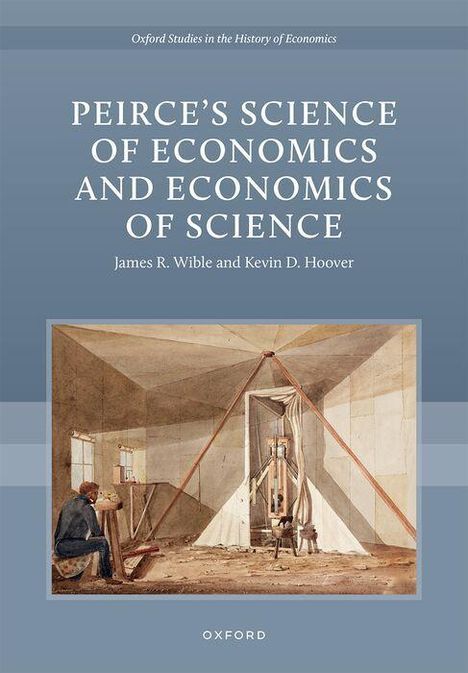
James R Wible: Peirceâs Science of Economics and Economics of Science, Kartoniert / Broschiert
Peirceâs Science of Economics and Economics of Science
(soweit verfügbar beim Lieferanten)
- Verlag:
- Oxford University Press, 09/2026
- Einband:
- Kartoniert / Broschiert
- Sprache:
- Englisch
- ISBN-13:
- 9780197839539
- Artikelnummer:
- 12620252
- Umfang:
- 416 Seiten
- Gewicht:
- 617 g
- Maße:
- 234 x 158 mm
- Stärke:
- 25 mm
- Erscheinungstermin:
- 16.9.2026
- Hinweis
-
Achtung: Artikel ist nicht in deutscher Sprache!
Weitere Ausgaben von Peirceâs Science of Economics and Economics of Science |
Preis |
|---|---|
| Buch, Gebunden, Englisch | EUR 186,29* |
Klappentext
Charles S. Peirce (1839-1914) is most famous today as a philosopher, the founder of the philosophical school of Pragmatism, and as a logician. In his own day, he was better known as a bench scientist, astronomer, and metrologist, renowned in the international scientific community for his measurements of gravity. Peirce was, in fact, one of history's great polymaths: mathematician, a founder of semiotics and one of the earliest experimental psychologists, as well as a contributor to a number of other disciplines, lexicography, and for decades a scientific contributor to The Nation . Perhaps the least understood of Peirce's many contributions are his forays into economics. In the 1870s, no one in the world had a better understanding of mathematical economics or its applications to real-world problems.
Peirce's Science of Economics and Economics of Science is a careful examination of his engagement with economics. It takes an interdisciplinary approach. As history of economics, it reconstructs how Peirce came to possess a cutting-edge knowledge of mathematical economics at the dawn of the so-called "marginalist revolution," how he used that knowledge in concrete applications, and how he understood the nature of economics as a science. As a wider history of science, it shows how Peirce created the economics of science out of a whole cloth as part of resolving methodological problems that arose in his work of measuring gravity. The book explores applications of Peirce's ideas about economics to some long-standing problems in the philosophy of science and shows how these ideas have implications for real-world science.