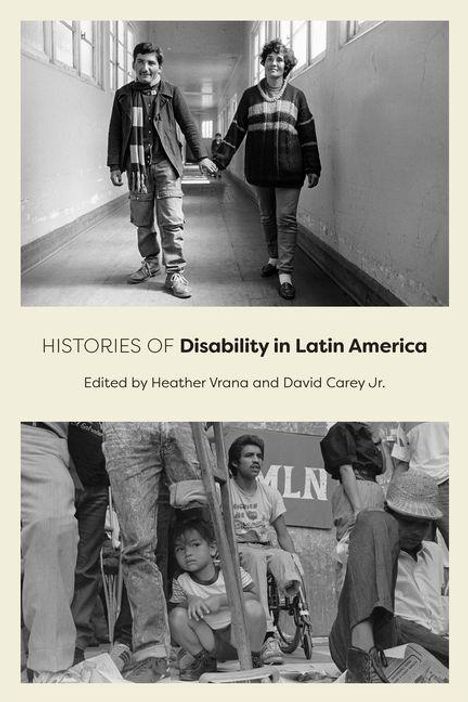
Heather Vrana: Histories of Disability in Latin America, Kartoniert / Broschiert
Histories of Disability in Latin America
(soweit verfügbar beim Lieferanten)
- Herausgeber:
- David Carey
- Verlag:
- Johns Hopkins University Press, 02/2026
- Einband:
- Kartoniert / Broschiert
- Sprache:
- Englisch
- ISBN-13:
- 9781421454054
- Artikelnummer:
- 12392760
- Umfang:
- 310 Seiten
- Gewicht:
- 506 g
- Maße:
- 229 x 152 mm
- Stärke:
- 22 mm
- Erscheinungstermin:
- 3.2.2026
- Hinweis
-
Achtung: Artikel ist nicht in deutscher Sprache!
Klappentext
Reframing disability, power, and identity in Latin America's complex histories.
Histories of Disability in Latin America offers a sweeping reexamination of disability's place in the region's past, bringing together original scholarship by historians and anthropologists to illuminate how bodies, minds, and the concept of difference have been understood across centuries of Latin American history. Edited by Heather Vrana and David Carey Jr., this volume foregrounds the lived experiences, agency, and social meanings of disability in a region too often marginalized in global disability studies.
With contributions and case studies based on archival and ethnographic research, the book illustrates how colonialism, slavery, war, industrialization, imperialism, and revolution have generated both disability and distinctive conceptions of disability. Rather than applying rigid Western frameworks, contributors examine Indigenous and Afro-Latin American terminologies and epistemologies to explore how societies have made sense of bodily difference, care, and capacity. In doing so, they critically engage medicalized and deficit-based interpretations that have long dominated historical and scholarly narratives. This collection shifts the center of inquiry to Latin America, interrogates presentist assumptions, and reconsiders the historical emergence of disability through the prisms of race, class, gender, and power.
Histories of Disability in Latin America engages and expands key debates in both disability studies and Latin American historiography. This book invites readers to rethink what disability has meant-and continues to mean-across time and place. It is essential reading for those interested in the entanglements of embodiment, identity, and the historical forces that have shaped life in the Americas.