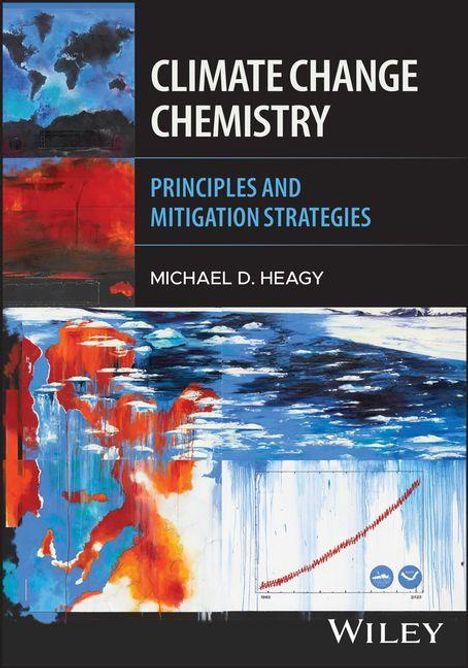
Heagy: Understanding Climate Change: Chemical Principles and Mitigation Strategies, Gebunden
Understanding Climate Change: Chemical Principles and Mitigation Strategies
- Principles and Mitigation Strategies
(soweit verfügbar beim Lieferanten)
- Verlag:
- Wiley, 04/2026
- Einband:
- Gebunden
- Sprache:
- Englisch
- ISBN-13:
- 9781119891376
- Artikelnummer:
- 11440198
- Umfang:
- 384 Seiten
- Gewicht:
- 666 g
- Maße:
- 251 x 175 mm
- Stärke:
- 25 mm
- Erscheinungstermin:
- 6.4.2026
- Hinweis
-
Achtung: Artikel ist nicht in deutscher Sprache!
Klappentext
ENABLES READERS TO RESEARCH CHEMICAL SOLUTIONS FOR GREENHOUSE GAS MITIGATION BY PROVIDING BACKGROUND ON THE CHEMICAL NATURE OF GAS EMISSIONS
Climate Change Chemistryoffers a historical as well as geographical basis on the chemistry of acid rain, ozone depletion, and the current increase in CO2; through this perspective, the book provides chemical solutions to acid rain and ozone depletion. Instead of traditional subdisciplinary chemical subjects, this book uses a unique pedagogical approach that integrates broader impact topics by way of international agreements and protocols achieved and the chemical strategies used to address environmental crises.
Readers will gain a historical and quantum chemistry perspective of the solar spectrum, learn to derive molecular orbitals, gather an understanding of group theory, and apply these concepts to chemical reactivity and molecular spectroscopy. The textbook provides a basis for continued research and development of these theories by introducing topics like solar fuels, the artificial leaf, photocatalysis, fuel cells, and conceptual solutions such as solar islands. It also presents a focused approach on chemical remediation of acid rain, fluorocarbons, and greenhouse gases such as CO2 and methane.
Climate Change Chemistry explores topics including:
- Fundamentals of quantum mechanics, covering the connection between quantum chemistry and the stars, the photoelectric effect, and the uncertainty principle
- Chemical bonding, covering formal charges, oxidation states, bonding, antibonding, and nonbonding MOs, and electron configurations for 2nd row homonuclear diatomics
- Molecular orbital theory and the applications of electronic structure up to polyatomic molecules
- Hydrogen production via artificial photosynthesis and water oxidation
- Why some gases are greenhouse gases and others are not
Climate Change Chemistry is an ideal semester course textbook for senior-level majors and graduate students in Chemistry, Chemical Engineering, and Materials Science programs of study that address climate change. The book may also be used by professionals in the field.