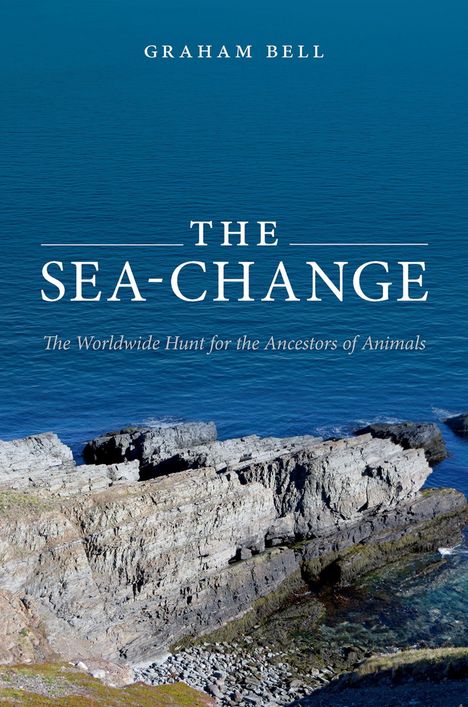
Graham Bell: The Sea-Change, Kartoniert / Broschiert
The Sea-Change
- The Worldwide Hunt for the Ancestors of Animals
(soweit verfügbar beim Lieferanten)
- Verlag:
- Oxford University Press, 05/2026
- Einband:
- Kartoniert / Broschiert
- Sprache:
- Englisch
- ISBN-13:
- 9780197797433
- Artikelnummer:
- 12669557
- Umfang:
- 320 Seiten
- Gewicht:
- 558 g
- Maße:
- 233 x 157 mm
- Stärke:
- 14 mm
- Erscheinungstermin:
- 29.5.2026
- Hinweis
-
Achtung: Artikel ist nicht in deutscher Sprache!
Klappentext
The Sea-Change: The Worldwide Hunt for the Ancestors of Animals is about one of the most absorbing puzzles in the whole of science: how the earliest animals lived, and what they looked like. These questions have haunted biology for two centuries because the facts seem to challenge its central dogma, the theory of evolution by natural selection.
One of the main objections to Darwin's theory of evolution was that the earliest fossils are already large and complex animals, with no sign of the simpler predecessors that the theory requires. They were the trilobites, marine arthropods about the size of a hand that crawled on the seabed half a billion years ago. Darwin was well aware of this flaw. He admitted its force, and postulated, without evidence, that before trilobites evolved the seas must have swarmed with life. We now know that he was right, and that the oldest fossils appeared 50 million years previously. Indeed, modern molecular biology concludes that animals first evolved at least 700 million years ago, long before the first fossils. The fossil record has now been pushed back to about 565 million years old, from the Ediacaran period that preceded the Cambrian. These fossils too are quite large, but they are very odd indeed, so odd that some have denied that they were animals at all.
Graham Bell reviews the fossil record of the earliest animals and draws two controversial conclusions. There was a long-hidden history of the first animals, which were minute and soft-bodied, so left no fossils. They lived on the sea floor and gradually assembled the genetic architecture required for development. Second, most of the Ediacaran fossils were not animal, but a completely different kind of large organism. These two conclusions together lead to a detailed narrative of the stages involved in the early evolution of animals, leading up to the 'Cambrian explosion' which laid the basis of modern biodiversity.