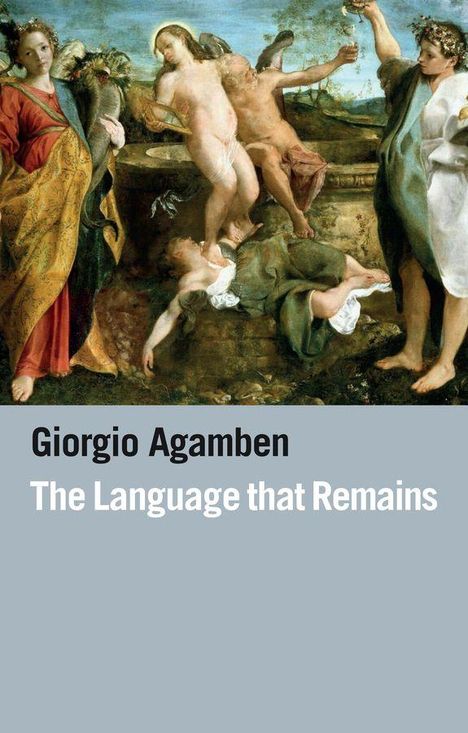
Giorgio Agamben: The Language That Remains, Gebunden
The Language That Remains
Sie können den Titel schon jetzt bestellen. Versand an Sie erfolgt gleich nach Verfügbarkeit.
- Übersetzung:
- Scott Kirkland
- Verlag:
- Polity Press, 10/2026
- Einband:
- Gebunden
- Sprache:
- Englisch
- ISBN-13:
- 9781509570447
- Artikelnummer:
- 12682014
- Umfang:
- 182 Seiten
- Erscheinungstermin:
- 22.10.2026
- Hinweis
-
Achtung: Artikel ist nicht in deutscher Sprache!
Weitere Ausgaben von The Language That Remains |
Preis |
|---|---|
| Buch, Kartoniert / Broschiert, Englisch | EUR 24,52* |
Klappentext
Time, language, and history: in this book Giorgio Agamben examines how, in Western culture, these three fundamental concepts have become tangled up in a knot that we can no longer unravel.
From this perspective, the book considers the critical importance of chronology, which is not a neutral convention but the breach through which theology penetrates into history; the nexus between history and eschatology in the doctrine of the Antichrist and the dizzying recapitulation of the dying as they see their entire lives parade before their eyes; the mundus, which in Roman cities was the name of the threshold that connected the past and the present, the world of the living and the one of the dead; and the difference between Chronos, time that devours its children, and kairos, the moment when an opportunity is seized. And, in Hannah Arendt's words, when everything seems to have lost its meaning, if what remains and what we bring with us is language, what is the language that remains?
Biografie (Giorgio Agamben)
Giorgio Agamben wurde 1942 in Rom geboren. Er studierte Jura, nebenbei auch Literatur und Philosophie. Der entscheidende Impuls für die Philosophie kam allerdings erst nach Abschluß des Jura-Studiums über zwei Seminare mit Martin Heidegger im Sommer 1966 und 1968. Neben Heidegger waren seitdem Michel Foucault, Hannah Arendt und Walter Benjamin wichtige Bezugspersonen in Agambens Denken. §Als Herausgeber der italienischen Ausgabe der Schriften Walter Benjamins fand Agamben eine Reihe von dessen verloren geglaubten Manuskripten wieder auf. Seit Ende der achtziger Jahre beschäftigt sich Agamben vor allem mit politischer Philosophie. Er lehrt zur Zeit Ästhetik und Philosophie an den Universitäten Venedig und Marcerata und hatte Gastprofessuren u.a. in Paris, Berkeley, Los Angeles, Irvine.§