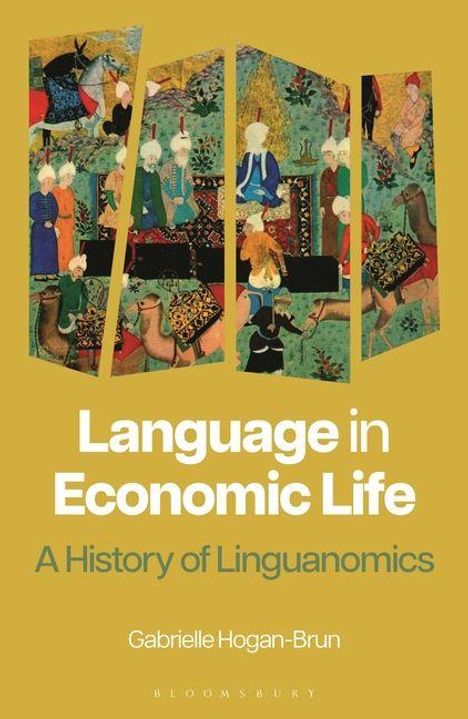
Gabrielle Hogan-Brun: Language in Economic Life, Gebunden
Language in Economic Life
- A History of Linguanomics
Sie können den Titel schon jetzt bestellen. Versand an Sie erfolgt gleich nach Verfügbarkeit.
- Verlag:
- Bloomsbury Academic, 08/2027
- Einband:
- Gebunden
- Sprache:
- Englisch
- ISBN-13:
- 9781350351882
- Artikelnummer:
- 12716815
- Umfang:
- 256 Seiten
- Gewicht:
- 454 g
- Maße:
- 198 x 129 mm
- Stärke:
- 25 mm
- Erscheinungstermin:
- 7.8.2027
- Hinweis
-
Achtung: Artikel ist nicht in deutscher Sprache!
Weitere Ausgaben von Language in Economic Life |
Preis |
|---|---|
| Buch, Kartoniert / Broschiert, Englisch | EUR 39,15* |
Klappentext
**This engaging book charts why and how humans have always benefitted from knowing and using languages.**Nowadays, multilingualism is known to be an economic resource that can benefit individuals, organisations, and society. Enterprises that embrace different languages are known to be more successful and innovative, but has that always been the case?
Building on the foundations of Gabrielle Hogan-Brun's earlier work, Linguanomics: *What is the Market Potential of Multilingualism?,*this book takes an historic look at the connections between multilingualism and economic development. Bringing to light the language lives of travellers, entrepreneurs, explorers and scholars, it shows that, across the globe, people have always drawn on their multilingual skills, using them as a resource to gain knowledge and power through contacts and negotiations across cultures. Their stories are still relevant today and illustrate multilingualism's enduring power to shape how we live and connect with one another.
Tracing the socio-economic realities of our polyglot past, the book deals with questions such as: How common was multilingualism? How important was it to learn languages? What did it mean to be multilingual? Modern-day international negotiations are necessarily across cultures, whether about climate change, World Trade Organisation rules or nuclear arms reduction talks. The lessons from history explored in this book give rise to optimism that we can learn how relevant our multilingual past is to understanding cross-cultural encounters today, highlighting multilingualism as a fundamental part not just of economic life, but in our ability to respond to wider environmental and social change.