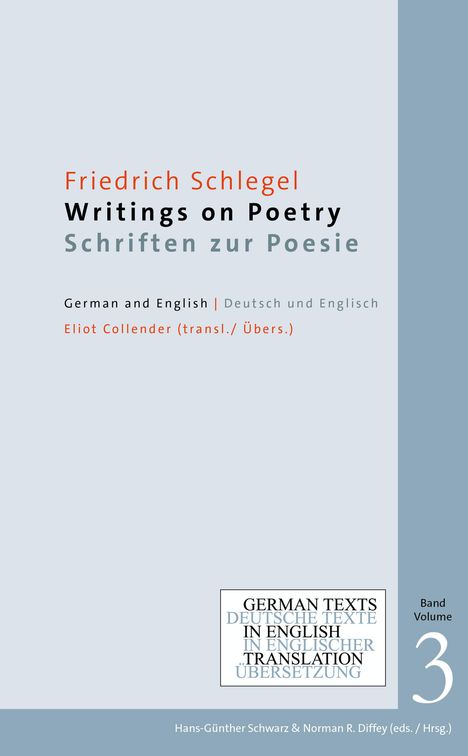
Friedrich Schlegel: Writings on Poetry / Schriften zur Poesie, Kartoniert / Broschiert
Writings on Poetry / Schriften zur Poesie
- German Texts in English Translation, Volume III. Deutsche Texte in englischer Übersetzung, Band III.
- Herausgeber:
- Hans-Günther Schwarz, Norman R. Diffey
- Übersetzung:
- Eliot Collender
- Verlag:
- Iudicium Verlag, 04/2026
- Einband:
- Kartoniert / Broschiert
- Sprache:
- Deutsch, Englisch
- ISBN-13:
- 9783862058143
- Artikelnummer:
- 12707076
- Umfang:
- 56 Seiten
- Gewicht:
- 86 g
- Maße:
- 205 x 127 mm
- Stärke:
- 6 mm
- Erscheinungstermin:
- 30.4.2026
Klappentext
This volume, the third in our series, introduces the reader to the foundations of German Romantic theory. German Romanticism is fundamentally different from English and French Romanticism. It was the first of many European movements of the same name and, after the Storm and Stress of the 1770's, again marked a radical departure from the Aristotelian tradition established in 17th century France. This departure was again inspired by Shakespeare, who became the decisive influence on German Theatre and still rules the German stage in our time. (...) The movement 'Romantik', emerging twenty years after the 'Sturm und Drang' and its realism, replaces the senses-eye and ear-with 'Geist' and 'Fantasie', or unlimited imagination. Goethe discovers Oriental Literature and its orientation towards the 'Märchen' as the incarnation of 'Geist'. His poetry and his notes in the 'Divan' reveal him to be a proponent of the ideas of 'Romantik'-an observation not acknowledged in traditional 'Germanistik' (German Studies). Like Goethe in his 'Divan', the German Romantics create new, nonexisting worlds through their unbounded 'Fantasie'. 'Natur', the observable world perceived by the senses, is replaced by 'Geist', the freedom of thought and resulting actions. 'Geist' is the creative, inventive, and ordering principle of mind or spirit. This ordering, observable in the abstract, nonrealistic patterns of Oriental carpets or in any artistic manifestation, inspired the 'déréaliser' and 'suggérer' of Symbolist art and literature. Both are artistic principles of Goethe's 'Divan' and the writings of Friedrich Schlegel and Novalis, the acknowledged founders of 'Romantik'. (...) The theory of Romantic poetry, as established in texts published in the 'Athenaeum' (1798-1800), was developed by Schlegel in Jena between 1797 and 1799. In 1799, Friedrich Schlegel moved from Jena to Cologne. His departure marked the end of the Jena circle and of the effort to establish a Romantic movement. As early as February 27, 1794, in a letter to his brother August Wilhelm, he was already outlining his Romantic programme. There he describes a poetic programme aiming at a "Vereinigung des Wesentlich-Modernen mit dem Wesentlich-Antiken" ("the unification of the essentially modern with the essentially ancient"). All his thoughts in the 'Gespräch über Poesie', from which we have selected the two most important passages, are united by a central thread: the synthesis of the Ancient and the Modern, understood as the unity of opposites. (From the Editors' Introduction)
Anmerkungen:
Bitte beachten Sie, dass auch wir der Preisbindung unterliegen und kurzfristige Preiserhöhungen oder -senkungen an Sie weitergeben müssen.