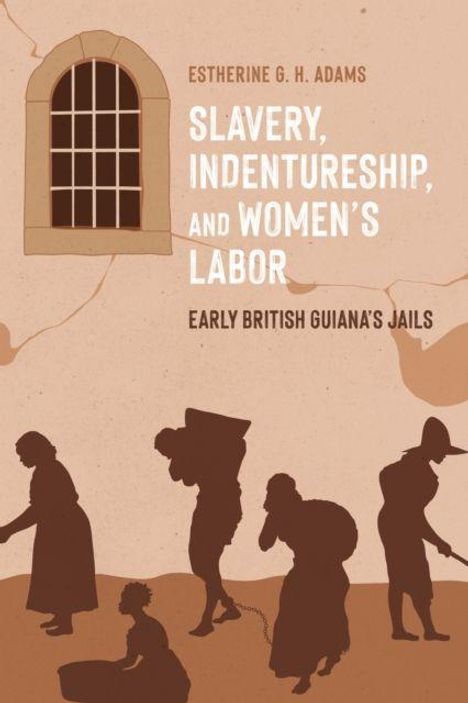
Estherine G. H. Adams: Slavery, Indentureship, and Women's Labor, Kartoniert / Broschiert
Slavery, Indentureship, and Women's Labor
- Early British Guiana's Jails
Sie können den Titel schon jetzt bestellen. Versand an Sie erfolgt gleich nach Verfügbarkeit.
- Verlag:
- University Press of Mississippi, 11/2026
- Einband:
- Kartoniert / Broschiert
- Sprache:
- Englisch
- ISBN-13:
- 9781496864109
- Artikelnummer:
- 12632807
- Umfang:
- 192 Seiten
- Erscheinungstermin:
- 16.11.2026
- Serie:
- Caribbean Studies Series
- Hinweis
-
Achtung: Artikel ist nicht in deutscher Sprache!
Weitere Ausgaben von Slavery, Indentureship, and Women's Labor |
Preis |
|---|---|
| Buch, Gebunden, Englisch | EUR 118,43* |
Klappentext
Slavery, Indentureship, and Women's Labor: Early British Guiana's Jails uncovers the overlooked histories of incarcerated women in colonial British Guiana, revealing how prisons evolved from sites of punishment into tools of labor extraction. Spanning the period from slavery through the end of indentureship, this groundbreaking study explores how the colonial state exploited the labor of imprisoned women---both African and immigrant---within a broader system of racial, gendered, and economic control.
Drawing on lived experiences as well as rich archival research from Guyana and the UK, the book challenges the conventional binary of slave versus free labor by showing how incarceration became a strategic method of coercing women into unpaid public and plantation work, monetizing the labor of incarcerated individuals to manage and manipulate the workforce in service of colonial economic interests. It also exposes the deliberate masculinization of imprisoned women to justify their use in physically demanding labor, stripping them of femininity to render their bodies more exploitable.
Organized into four thematic chapters, the book examines the transformation of the colonial prison system, the gendered nature of prison labor and resistance, the racialization of criminality, and the expansion of penal infrastructure in tandem with immigration schemes. Timely and deeply researched, this work offers new insight into the intersections of gender, race, labor, and carcerality in the Caribbean, appealing to readers interested in the roots of contemporary conversations around incarceration and historical injustice.