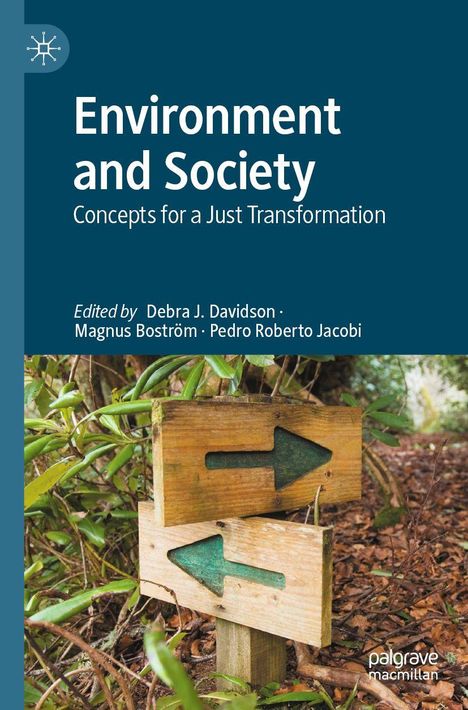
Environment and Society, Kartoniert / Broschiert
Environment and Society
- Concepts for a Just Transformation
(soweit verfügbar beim Lieferanten)
- Herausgeber:
- Debra J. Davidson, Magnus Boström, Pedro Roberto Jacobi
- Verlag:
- Springer, 08/2026
- Einband:
- Kartoniert / Broschiert
- Sprache:
- Englisch
- ISBN-13:
- 9783032270580
- Artikelnummer:
- 12862594
- Umfang:
- 256 Seiten
- Gewicht:
- 394 g
- Maße:
- 235 x 155 mm
- Stärke:
- 15 mm
- Erscheinungstermin:
- 21.8.2026
- Hinweis
-
Achtung: Artikel ist nicht in deutscher Sprache!
Klappentext
The second edition of Environment and Society: Concepts for a Just Transformation delivers a major, timely update to one of the field's most respected conceptdriven environmental social science texts. Fully revised and significantly re-oriented to highlight concepts informing social projects in just transformation, this edition reshapes the book around an enhanced set of contemporary concepts---adding new chapters, removing outdated material, and thoroughly updating those retained---to reflect the dramatic shifts in how scholars, policymakers, and communities understand society--environment relations. With contributions from an even more globally diverse group of authors, the book now brings stronger representation from the Global South and a wider array of disciplinary perspectives.
The book examines whether today's dominant ideas and conceptual frameworks meaningfully support a "Just Transformation" in the face of deepening environmental and climatological crises. Across eleven conceptfocused chapters---ranging from justice, colonialism, and intersectionality to futures, metabolism, collective action, commons, footprints, and more---contributors offer accessible syntheses, illustrative examples, and endofchapter discussion topics designed for classroom use.
This edition is designed for advanced undergraduate and graduate students across environmental studies, environmental sociology, geography, sustainability, and allied social sciences, as well as scholars seeking a clear, comparative resource on conceptual trends. It will also appeal to practitioners, NGO staff, and policy professionals who require a deeper understanding of the conceptual tools shaping environmental thinking today.