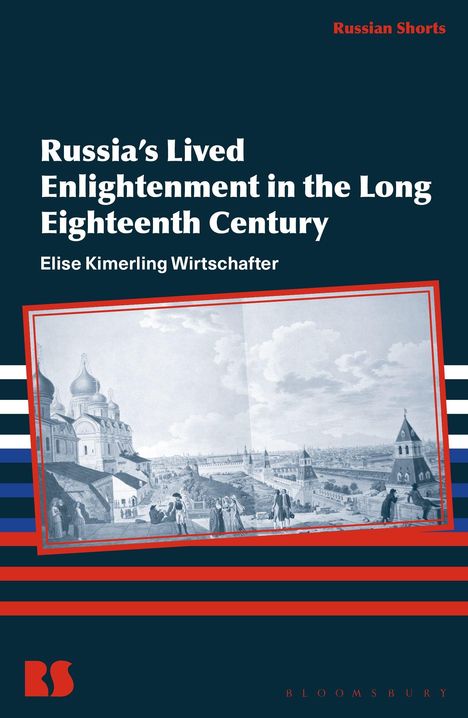
Emeritus Elise Kimerling Wirtschafter: Russia's Lived Enlightenment in the Long Eighteenth Century, Kartoniert / Broschiert
Russia's Lived Enlightenment in the Long Eighteenth Century
Sie können den Titel schon jetzt bestellen. Versand an Sie erfolgt gleich nach Verfügbarkeit.
- Verlag:
- Bloomsbury Publishing PLC, 01/2027
- Einband:
- Kartoniert / Broschiert
- Sprache:
- Englisch
- ISBN-13:
- 9781350517554
- Artikelnummer:
- 12717016
- Umfang:
- 128 Seiten
- Erscheinungstermin:
- 7.1.2027
- Serie:
- Russian Shorts
- Hinweis
-
Achtung: Artikel ist nicht in deutscher Sprache!
Weitere Ausgaben von Russia's Lived Enlightenment in the Long Eighteenth Century |
Preis |
|---|---|
| Buch, Gebunden, Englisch | EUR 67,01* |
Klappentext
Elise Kimerling Wirtschafter convincingly argues that the Russian Enlightenment is best described as a lived Enlightenment-the commitment to and the practice of living an enlightened life. Wirtschafter examines the Russian Enlightenment with reference to the monarchy (or state), the Russian Orthodox Church, and the educated service classes.
Russia's Lived Enlightenment in the Long Eighteenth Century shows that, for the monarchy, Enlightenment principles provided effective mechanisms and ideological justifications for state building, resource mobilization, and the imposition of social control. For the Church, which long had been Russia's primary center of higher learning, Enlightenment thought introduced new forms of philosophical and scientific knowledge that had to be brought into the fold of Orthodox religious belief. For Russia's educated classes, which remained service classes until the second quarter of the 19th century, Enlightenment culture and sociability became vehicles for developing the independent moral voice of an emergent public (publika) or civil society of the educated (obshchestvo).
The book reveals that representatives of the monarchy, Church, and educated classes contributed to the Enlightenment in different ways, including the spread of ideas identified with Enlightenment thought in Central and Western Europe. Overall, Wirtschafter contends, Russian enlighteners sought to promote imperial greatness, reform human behavior, and encourage material, social, and cultural progress, without abandoning tradition or overturning political and social arrangements.