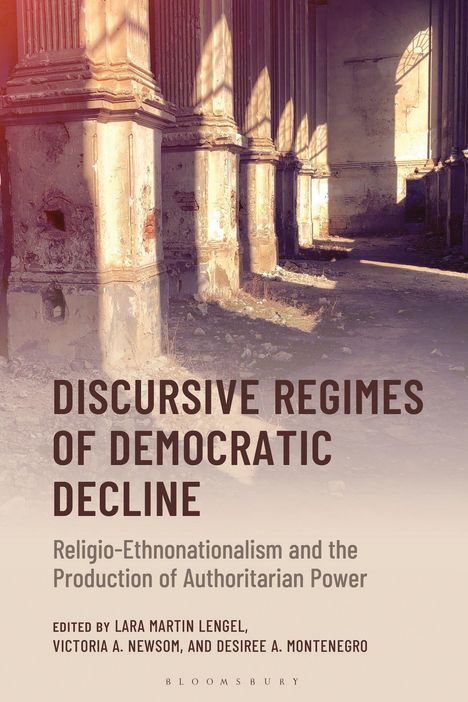
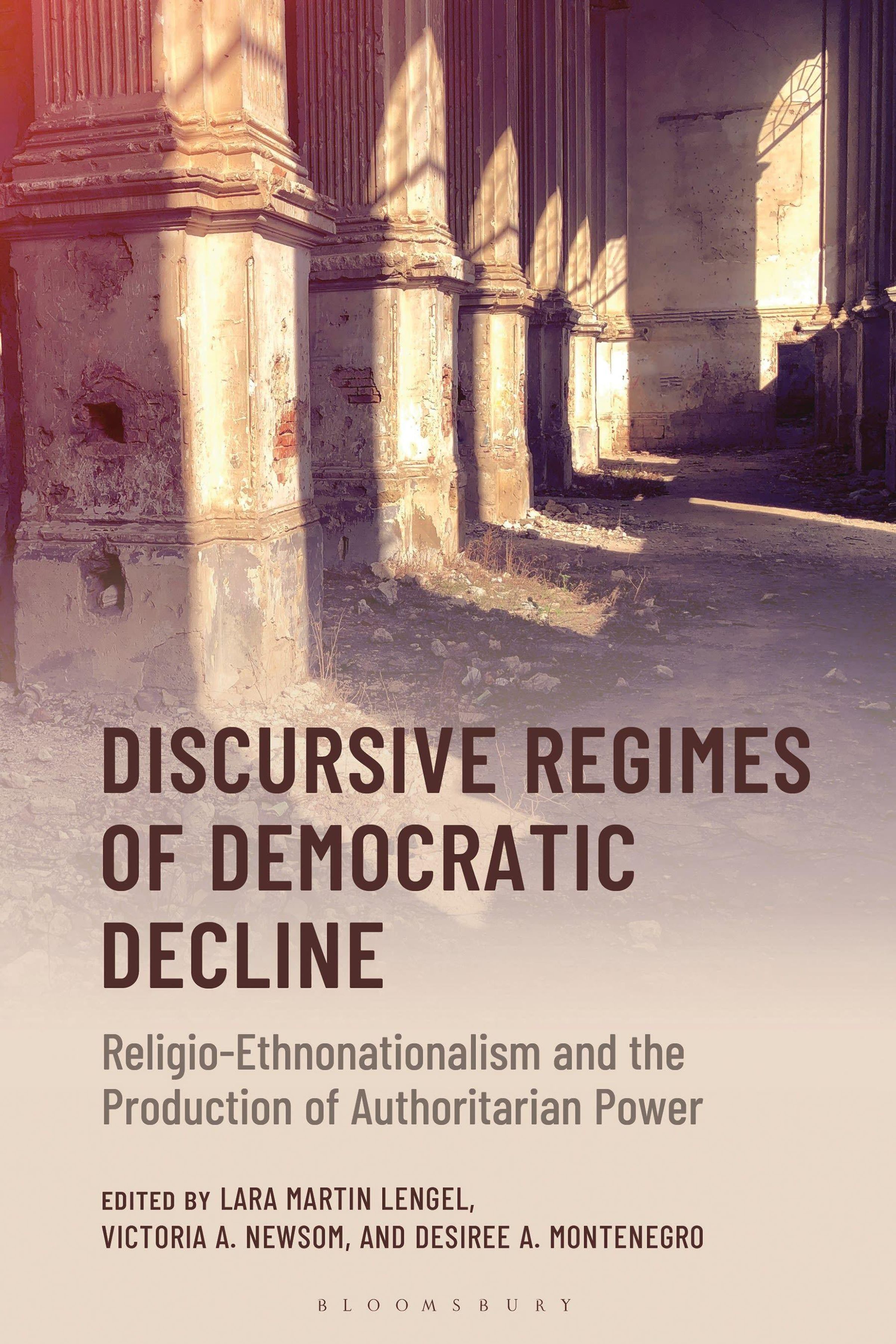
Discursive Regimes of Democratic Decline, Gebunden
Discursive Regimes of Democratic Decline
- Religio-Ethnonationalism and the Production of Authoritarian Power
Sie können den Titel schon jetzt bestellen. Versand an Sie erfolgt gleich nach Verfügbarkeit.
- Herausgeber:
- Lara Martin Lengel, Victoria A. Newsom, Desiree A. Montenegro
- Verlag:
- Bloomsbury Publishing plc, 11/2026
- Einband:
- Gebunden
- Sprache:
- Englisch
- ISBN-13:
- 9781666944549
- Artikelnummer:
- 12758916
- Umfang:
- 336 Seiten
- Gewicht:
- 453 g
- Maße:
- 229 x 153 mm
- Stärke:
- 18 mm
- Erscheinungstermin:
- 12.11.2026
- Hinweis
-
Achtung: Artikel ist nicht in deutscher Sprache!
Klappentext
An international group of esteemed scholars examines how religio-ethnonationalist power is communicatively produced, normalized, and resisted through discourse.
This edited volume moves beyond conceptions of democratic decline as a purely institutional or electoral phenomenon to advance our understanding of how religion, nationalism, and media power intersect in struggles over democracy. Foregrounding the communicative processes through which affective narratives of exclusion, tradition, and morality are mobilized to legitimate authoritarian power, contributors demonstrate how discourse is simultaneously leveraged as both a mechanism of domination and a site of contestation as it shapes memory, identity, citizenship, and political belonging.
Engaging interdisciplinary conversations across global contexts including North Macedonia, Malaysia, Nigeria, and the United States, contributors highlight not only how discursive tactics of amnesia, amnesty, and cleansing are utilized to sustain religio-ethnonationalist hierarchies but also how discursive resistance can be embraced to reveal the uneven conditions from which resistance emerges. By centering communication as a site of democratic struggle, this volume offers a conceptual framework for identifying how democratic backsliding is (re)produced and challenged, ultimately emphasizing the ethical and political stakes of memory, identity, and power in shaping the future of democracy.