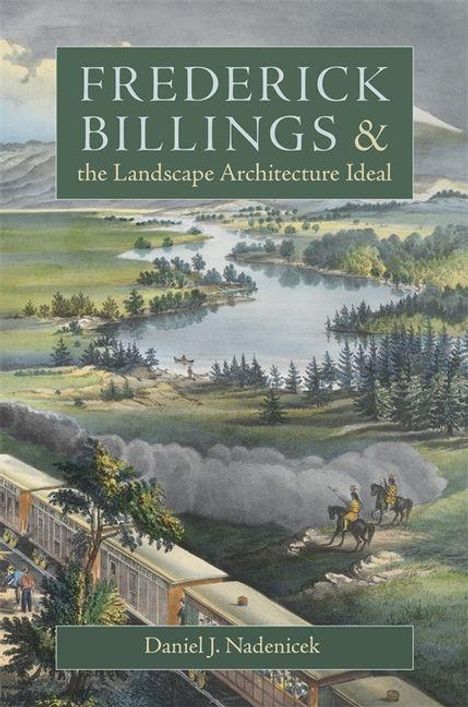
Daniel J Nadenicek: Frederick Billings and the Landscape Architecture Ideal, Gebunden
Frederick Billings and the Landscape Architecture Ideal
Sie können den Titel schon jetzt bestellen. Versand an Sie erfolgt gleich nach Verfügbarkeit.
- Verlag:
- University of Georgia Press, 11/2026
- Einband:
- Gebunden
- Sprache:
- Englisch
- ISBN-13:
- 9780820380698
- Artikelnummer:
- 12651411
- Umfang:
- 352 Seiten
- Erscheinungstermin:
- 15.11.2026
- Hinweis
-
Achtung: Artikel ist nicht in deutscher Sprache!
Klappentext
Today, Americans regard access to recreational landscapes as something of a human right and see a direct connection between landscape experiences and health. These assumptions have their philosophical foundations in the nineteenth century and are inextricably linked to the massive social and environmental disruptions of nation building. From the 1820s until the brink of the progressive era in the 1890s, a connected set of landscape conservation, planning, design, and management strategies focused on environmental action and social improvement were conceived and implemented across the nation. This movement, for Nadenicek, is best understood as a "landscape architecture ideal." While Frederick Law Olmstead is usually the heroic figurehead in explaining those nineteenth-century landscape-based theories and actions, in Frederick Billings and the Landscape Architecture Ideal, Nadenicek sees Billings as a rather more forgotten contributor to the development of that ideal, along with numerous other landscape designers, writers, artists, and wealthy experimenters.
A child of Vermont, Billings traveled to California in 1849 and, during the Gold Rush years, made a fortune in real estate development and as a land lawyer. During the 1870s, he joined the Northern Pacific Railroad--America's second transcontinental railroad--Board of Directors, where he chaired the Land Committee and served as NPRR president. The city of Billings, Montana bears his name, as does a small town in Missouri, a North Dakota county, two ships, and the Marsh-Billings-Rockefeller National Historical Park in his hometown of Woodstock, Vermont. But Billings was a man of paradox--he saw the landscape as a commodity and ripe for conquest at the same time as he saw it as necessary for individual and community advancement.