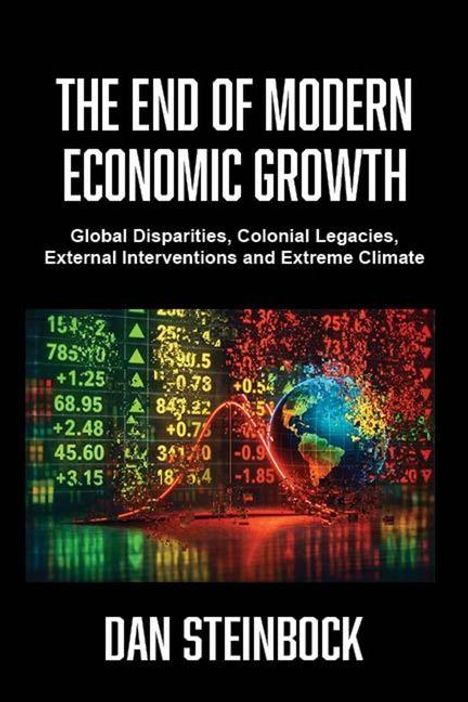
Dan Steinbock: The Eclipse of Modern Economic Growth, Kartoniert / Broschiert
The Eclipse of Modern Economic Growth
- Global Disparities, Colonial Legacies, External Interventions and Extreme Climate
Lassen Sie sich über unseren eCourier benachrichtigen, sobald das Produkt bestellt werden kann.
- Verlag:
- Clarity Press, 10/2026
- Einband:
- Kartoniert / Broschiert
- Sprache:
- Englisch
- ISBN-13:
- 9781963892383
- Umfang:
- 344 Seiten
- Gewicht:
- 454 g
- Maße:
- 229 x 152 mm
- Stärke:
- 25 mm
- Erscheinungstermin:
- 1.10.2026
- Hinweis
-
Achtung: Artikel ist nicht in deutscher Sprache!
Ähnliche Artikel


Klappentext
What's the common denominator underpinning ongoing global turmoil: affordability crises, youth protests, proxy conflicts, trade protectionism, populism, migration crises, and extreme weather? Simply put: The end of modern economic growth.
In the 15th century, colonization opened the world markets for the nascent West's plunder. But without systematic technological innovation, per capita income remained low. With the rise of capitalism, the constraints on growth were dismantled. But this familiar story of modernization has a darker side.
With the rise of Western modernity, inequality soared within and between economies. The first countries to colonize were the first to industrialize, and the early industrializers were the first to globalize. Conversely, those areas that were colonized in the Americas, Asia, the Middle East and Africa have been late to industrialize and only a few have begun to globalize.
The net effect has been an immense net transfer of wealth from the Global South to the West and huge disparities between these regions. To sustain this supremacy, the West has consistently used external interventions to undermine sovereign states and extract their resources, in both processes unleashing extreme climate change.
This book connects the unacknowledged dots behind the standard narratives.
The Prologue offers a contrarian introduction to the rise and fall of modern economic growth.
Part I outlines the growth dialectic from colonization to industrialization and globalization. These include the West's external interventions, from coups and regime changes to full demodernization. It highlights the colossal economic, human and climate costs of this trajectory.
Part II identifies the true stages of economic growth from Malthusian stagnation to industrialization, to the market economy and the slow transition to sustainability. It demystifies the classic modernization narrative in empirical detail, subverting the standard narrative.
The Epilogue explains how the era of "economic miracles" is not just stagnating but coming to an end.
Challenging conventional wisdom, the book covers all major economies and its time span ranges from 1500 to projections up to 2100. It is about missed opportunities and the attendant colossal economic and human costs.
It also addresses viable alternative futures that could be more inclusive and sustainable.