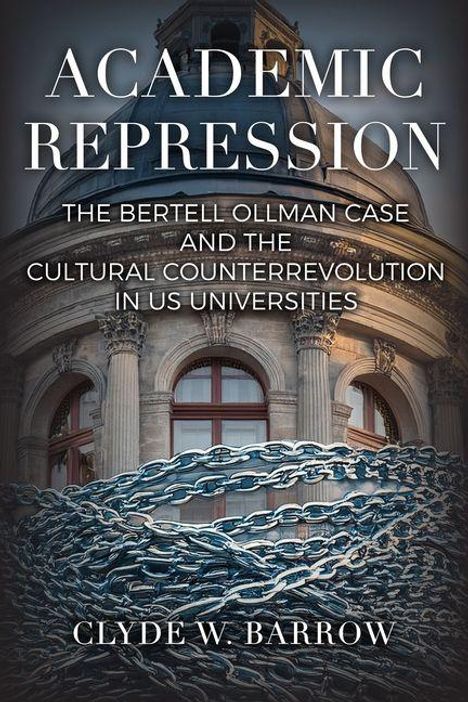
Clyde W Barrow: Academic Repression, Gebunden
Academic Repression
- The Bertell Ollman Case and the Cultural Counterrevolution in Us Universities

Sie können den Titel schon jetzt bestellen. Versand an Sie erfolgt gleich nach Verfügbarkeit.
- Verlag:
- State University of New York Press, 03/2027
- Einband:
- Gebunden
- Sprache:
- Englisch
- ISBN-13:
- 9798855811698
- Artikelnummer:
- 12919595
- Umfang:
- 224 Seiten
- Gewicht:
- 431 g
- Erscheinungstermin:
- 1.3.2027
- Hinweis
-
Achtung: Artikel ist nicht in deutscher Sprache!
Klappentext
The first comprehensive, in-depth analysis of the Bertell Ollman academic freedom case.
In 1978, Dr. Bertell Ollman, a self-identified Marxist, had his appointment as chair of the department of political science at the University of Maryland overturned by the university president. This action was taken after conservative faculty enlisted the support of the governor, state legislators, corporate executives, and neoconservative media pundits to wage a public smear campaign against Ollman. Academic Repression is the first comprehensive, in-depth, analysis of the Ollman academic freedom case (1978--1985) based on an analysis of trial transcripts, written judicial opinions, reports by professional associations, autobiographical statements, contemporaneous media reports, and relevant scholarly literature. Clyde W. Barrow argues that the Ollman case was the opening shot in a cultural counterrevolution that now defines the academic politics of US universities. He further illustrates this thesis with an autoethnographic account of his own experience with academic repression. Finally, Barrow deploys the Ollman case as a platform for criticizing the liberal concept of academic freedom, which he argues is not a right, but an asymmetrical relationship of class power between intellectuals and the capitalist class. The final chapter of the book argues that the problem of academic repression will only be solved when university intellectuals seize control of what Marx and Engels called the material means of mental production--the universities. Only then can they establish a genuinely autonomous self-governing community of scholars.