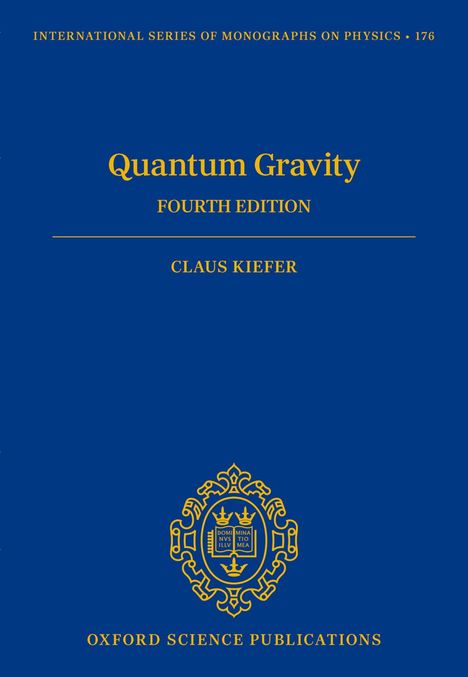
Claus Kiefer: Quantum Gravity, Gebunden
Quantum Gravity
- Fourth Edition
(soweit verfügbar beim Lieferanten)
- Verlag:
- Oxford University Press, 08/2025
- Einband:
- Gebunden
- Sprache:
- Englisch
- ISBN-13:
- 9780198842132
- Artikelnummer:
- 12213831
- Umfang:
- 448 Seiten
- Nummer der Auflage:
- 25004
- Ausgabe:
- 4th edition
- Gewicht:
- 1030 g
- Maße:
- 253 x 177 mm
- Stärke:
- 26 mm
- Erscheinungstermin:
- 31.8.2025
- Hinweis
-
Achtung: Artikel ist nicht in deutscher Sprache!
Weitere Ausgaben von Quantum Gravity |
Preis |
|---|
Klappentext
The description of Nature in physics currently falls into two parts: the microscopic and the macroscopic. The microscopic world (molecules, atoms, particles) is described by quantum theory, whereas the macroscopic world (planets, stars, galaxies, universe) is ruled by a classical interaction - gravity - that is described by Einstein's theory of general relativity. This book describes in detail the attempts to unify quantum theory and relativity, which are essential to understanding the origin of the Universe and the final fate of black holes.
The construction of a consistent quantum theory is among the most important open problems in fundamental physics. This book describes the motivation for constructing such a theory and presents the main approaches. These approaches include covariant quantization, canonical quantization (metric and loop approaches), and string theory. The book also covers the main applications, which include black holes and cosmology.
This new edition includes updated content throughout, as well as further explorations of the holographic principle, unimodular gravity, quantum-gravitational correction terms, and possible observations, as these are topics that have experienced important developments since the last edition.
Biografie
Claus Kiefer studierte Physik und Astronomie an den Universitäten Heidelberg und Wien. Er promovierte 1988 in Heidelberg über den Begriff der inneren Zeit in der kanonischen Quantentheorie der Gravitation, habilitierte sich 1995 und lehrte an den Universitäten Zürich und Freiburg. Längere Aufenthalte unter anderem an der University of Cambridge, der Université de Montpellier und dem Wissenschaftskolleg zu Berlin. Seit 2001 ist er Professor für Theoretische Physik an der Universität zu Köln.