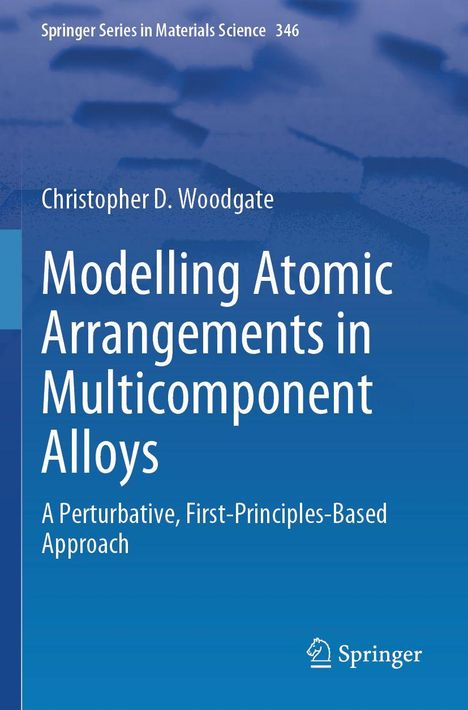
Christopher D. Woodgate: Modelling Atomic Arrangements in Multicomponent Alloys, Kartoniert / Broschiert
Modelling Atomic Arrangements in Multicomponent Alloys
- A Perturbative, First-Principles-Based Approach
(soweit verfügbar beim Lieferanten)
- Verlag:
- Springer, 08/2025
- Einband:
- Kartoniert / Broschiert
- Sprache:
- Englisch
- ISBN-13:
- 9783031620232
- Artikelnummer:
- 12870390
- Umfang:
- 224 Seiten
- Gewicht:
- 388 g
- Maße:
- 235 x 155 mm
- Stärke:
- 12 mm
- Erscheinungstermin:
- 13.8.2025
- Serie:
- Springer Series in Materials Science - Band 346
- Hinweis
-
Achtung: Artikel ist nicht in deutscher Sprache!
Klappentext
This book provides a comprehensive overview of a computationally efficient approach for modelling the phase behaviour of multicomponent alloys from first principles, describing both short- and long-range atomic ordering tendencies. The study of multicomponent alloy systems, which combine three or more base elements in near-equal ratios, has garnered significant attention in materials science due to the potential for the creation of novel materials with superior properties for a variety of applications. High-entropy alloys, which contain four or more base elements, have emerged as a particularly fascinating subset of these systems, demonstrating extraordinary strength and fracture resistance, among other desirable properties. The book presents a novel modelling approach for studying the phase behaviour of these systems, which is based on a perturbative analysis of the internal energy of the disordered alloy as evaluated within the Korringa-Kohn-Rostoker (KKR) formulation of density functional theory (DFT), using the coherent potential approximation (CPA) to average over chemical disorder. Application of a Landau-type theory to an approximate form of the Gibbs free energy enables direct inference of chemical disorder / order transitions. In addition, the perturbative analysis facilitates extraction of atom-atom effective pair interactions for further atomistic simulations. The connection between the arrangement of atoms in a material and its magnetic properties is also studied. By outlining and applying the proposed modelling techniques to several systems of interest, this book serves as a valuable resource for materials scientists, physicists, and chemists alike, seeking to understand and develop new alloy systems with enhanced materials properties.