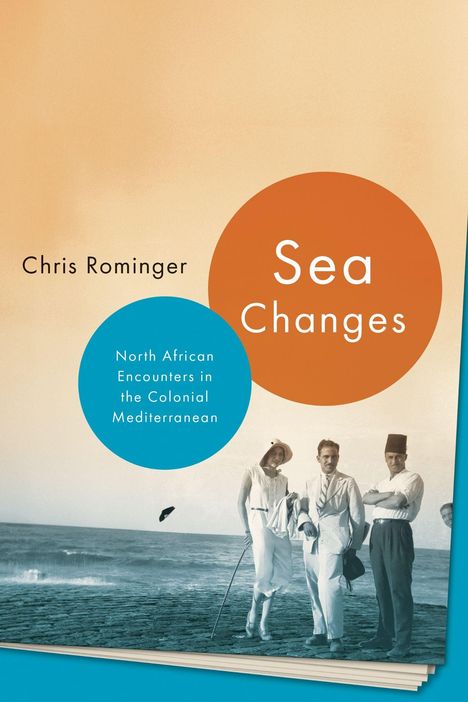
Chris Rominger: Sea Changes, Kartoniert / Broschiert
Sea Changes
- North African Encounters in the Colonial Mediterranean
Sie können den Titel schon jetzt bestellen. Versand an Sie erfolgt gleich nach Verfügbarkeit.
- Verlag:
- Stanford University Press, 12/2026
- Einband:
- Kartoniert / Broschiert
- Sprache:
- Englisch
- ISBN-13:
- 9781503648203
- Artikelnummer:
- 12645180
- Umfang:
- 280 Seiten
- Erscheinungstermin:
- 15.12.2026
- Hinweis
-
Achtung: Artikel ist nicht in deutscher Sprache!
Weitere Ausgaben von Sea Changes |
Preis |
|---|---|
| Buch, Gebunden, Englisch | EUR 168,61* |
Klappentext
At the turn of the twentieth century, confrontations between rival French, Italian, and Ottoman empires solidified national, colonial, and racial boundaries throughout the Mediterranean basin. Yet, even in the face of an emergent ethno-nationalist world order, these decades saw various North African transnational political movements thrive. Sea Changes examines how North Africans of diverse social and religious backgrounds forged new spaces and networks in which to envision border-crossing political alternatives, such as pan-Islamism, pan-Arabism, Zionism, and international leftism.
To unveil these alternative networks and political possibilities, Chris Rominger follows the trajectory of Jewish Tunisian photographer Albert Samama-Chikly (1872-1934) and his contacts from the 1870s to the 1920s. Not an overtly political man in any traditional sense, the highly-mobile Samama nonetheless found himself an intimate witness to some of the early twentieth century's most violent political dramas, including France's colonization of Tunisia, Italy's conquest of neighboring Libya, the forced conscription of North Africans during World War I, and the postwar birth of transnational and radical movements across North Africa. Emphasizing the border-crossing experiences of those who lived on the Mediterranean's southern shores, Sea Changes locates North Africa at the very heart of key transformations and imperial conflicts where diverse and fluid transimperial affinities clashed with emergent ethno-nationalist imperatives.