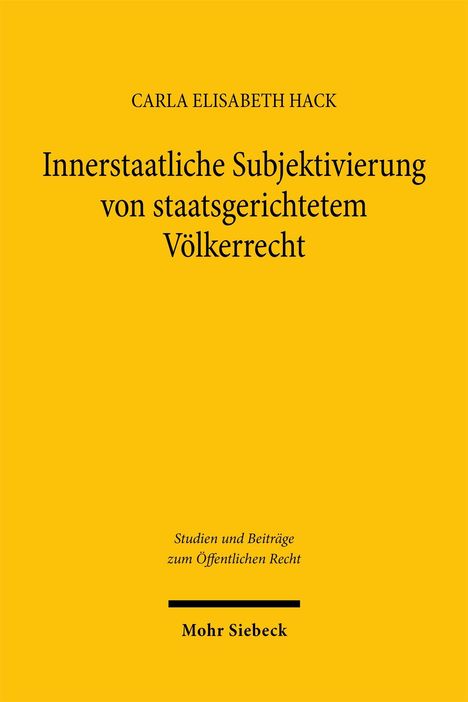
Carla Elisabeth Hack: Innerstaatliche Subjektivierung von staatsgerichtetem Völkerrecht, Kartoniert / Broschiert
Innerstaatliche Subjektivierung von staatsgerichtetem Völkerrecht
- Möglichkeit und Reichweite einer subjektivierten innerstaatlichen Adressatenerweiterung von staatsgerichteten allgemeinen Regeln des Völkerrechts über Artikel 25 Satz 2 Halbsatz 2 Grundgesetz am Beispiel des Umweltvölkerrechts
- Verlag:
- Mohr Siebeck GmbH & Co. K, 05/2026
- Einband:
- Kartoniert / Broschiert
- Sprache:
- Deutsch
- ISBN-13:
- 9783162004055
- Artikelnummer:
- 12579733
- Umfang:
- 312 Seiten
- Nummer der Auflage:
- 26001
- Ausgabe:
- 1. Auflage
- Gewicht:
- 460 g
- Maße:
- 229 x 153 mm
- Stärke:
- 17 mm
- Erscheinungstermin:
- 28.5.2026
- Serie:
- Studien und Beiträge zum Öffentlichen Recht
Klappentext
By virtue of Article 25 of the German Basic Law (Art. 25 GG), all general rules of international law are incorporated into domestic law and give rise to rights and duties for the inhabitants of the federal territory. Because individuals are granted rights and subjected to obligations without distinction, the central question arises whether all general rules of international law are capable of directly conferring rights and imposing obligations on individuals within the domestic sphere by way of a so-called extension of addressees ( Adressatenerweiterung ).
Carla Elisabeth Hack analyzes the domestic and international legal situation and subsequently assesses, in positive terms, a domestic extension of addressees for state-directed rules that have an individual dimension. This constitutive effect, however, does not apply without limitation; it is subject to the boundary of a specific individual nexus in the sense of being directed to individuals ( Individualgerichtetheit ). What is required is a close connection between the relevant general rule of international law and individual, highly ranked legal interests. The catalogue of criteria developed to concretize the concept of Individualgerichtetheit is applied in the field of international environmental law.
The author concludes that, with Article 25 GG, the Basic Law created a forward-looking mechanism for integrating international law and its developments effectively and directly into domestic law. The foundations for an effective subjectivized shift in addressees-translating state-directed international law into domestic law applicable to individuals-are likewise in place. However, the current stage of individual-oriented development in international environmental law does not yet permit a comprehensive extension of addressees in domestic law without undermining the intended congruence between national and international law.
Anmerkungen:
Bitte beachten Sie, dass auch wir der Preisbindung unterliegen und kurzfristige Preiserhöhungen oder -senkungen an Sie weitergeben müssen.
Mehr von Studien und Bei...
-
Henning SchaafDie Grundrechtswirkung auf das PrivatrechtsverhältnisBuchAktueller Preis: EUR 129,00
-
Luisa LehningMehrdimensionale DiskriminierungenBuchAktueller Preis: EUR 89,00
-
Maximilian PetrasVernetzte AutonomieBuchAktueller Preis: EUR 84,00
-
Markus KernPsychische Integrität und demokratische FreiheitlichkeitBuchAktueller Preis: EUR 79,00