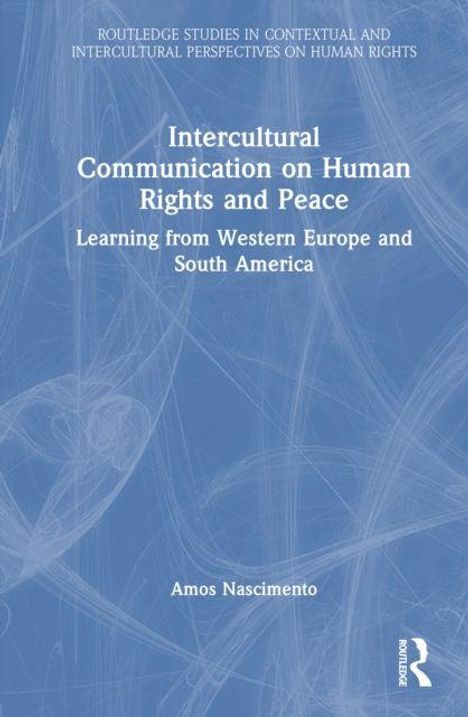
Amos Nascimento: Intercultural Communication on Human Rights and Peace, Gebunden
Intercultural Communication on Human Rights and Peace
- Learning from Western Europe and South America
Sie können den Titel schon jetzt bestellen. Versand an Sie erfolgt gleich nach Verfügbarkeit.
- Verlag:
- Taylor & Francis Ltd, 09/2026
- Einband:
- Gebunden
- Sprache:
- Englisch
- ISBN-13:
- 9781041159759
- Artikelnummer:
- 12824224
- Umfang:
- 296 Seiten
- Erscheinungstermin:
- 21.9.2026
- Serie:
- Routledge Studies in Contextual and Intercultural Perspectives on Human Rights
- Hinweis
-
Achtung: Artikel ist nicht in deutscher Sprache!
Weitere Ausgaben von Intercultural Communication on Human Rights and Peace |
Preis |
|---|---|
| Buch, Kartoniert / Broschiert, Englisch | EUR 66,40* |
Klappentext
This book brings together intercultural philosophy and human rights by focusing on how the theory and practice of human rights evolve differently in a plurality of contextual realities but coincide in the affirmation of key universal values.
Introducing a philosophical perspective on intercultural communication, the author considers Karl Jaspers's idea of the Axial Age but expands it in dialogue with authors such as Jürgen Habermas and Enrique Dussel, who help define "Axiality" as a broader framework to address the plurality of cultures and norms that influence geopolitics, economics, human rights, and peace today. Focusing on Western Europe and South America as two examples of regional integration, the author argues that emerging regional blocs are not simply a matter for political economy but also for considerations on normativity, historical progression or regression, democratic participation of civil society, and the promotion of human rights and peace. In each region there are alternative discourses, practices, and systems that reveal, promote, and teach these values. Understanding the plurality of initiatives supporting human rights and peace and using intercultural communication to learn about their common claim to universality can help us address the challenges we face in the 21st century.
This book will be of key interest to scholars and students of human rights, philosophy, political theory, history, anthropology, theology, international relations, policy studies, cultural studies, and more broadly to the wider humanities and social sciences.