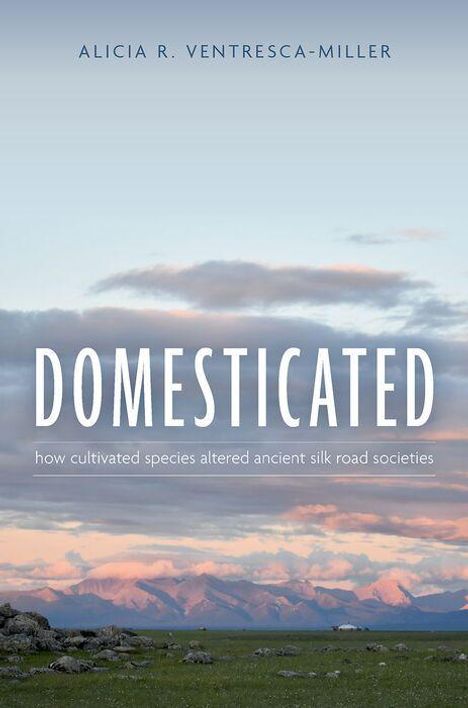
Alicia R Ventresca-Miller: Domesticated, Gebunden
Domesticated
- How Cultivated Species Altered Ancient Silk Road Societies

(soweit verfügbar beim Lieferanten)
- Verlag:
- Oxford University Press, 04/2026
- Einband:
- Gebunden
- Sprache:
- Englisch
- ISBN-13:
- 9780197785942
- Artikelnummer:
- 12564902
- Umfang:
- 296 Seiten
- Gewicht:
- 544 g
- Maße:
- 244 x 160 mm
- Stärke:
- 25 mm
- Erscheinungstermin:
- 2.4.2026
- Hinweis
-
Achtung: Artikel ist nicht in deutscher Sprache!
Klappentext
This is an open access title available under the terms of a CC BY-NC-ND 4.0 International licence. It is free to read at Oxford Academic and offered as a free PDF download from OUP and selected open access locations. Domesticated uses novel archaeological methods to rewrite the narrative of the rise of social complexity in the western and eastern Eurasian steppe. Through the study of ancient proteins, DNA, and isotopes, as well as traditional archaeology, Alicia R. Ventresca-Miller tracks the adoption of domesticated animals and plants to show how cultivated species transformed societies during the eras preceding the Silk Road networks. Economies in this region shifted from hunting and gathering to the use of ruminant livestock, horse dairying and riding, and finally to the cultivation of grains, marking major thresholds in human history. Ventresca-Miller proposes a model for how this happened--from the initial introduction of the animal or plant to their acceptance, solidification, and intensification--and shows how each stage of development impacted the ways local communities interacted, settled in the landscape, and gave rise to new social structures.
The management of domesticated species and the alteration of landscapes allowed communities in north-central Asia to build complex societies and long-distance trading networks, which linked cities and supported Empires. In Domesticated, a nuanced narrative emerges, one that situates north-central Asia as a vital locale for the study of the adoption of domesticated species and underscores how these developments contributed to alternative forms of social complexity.