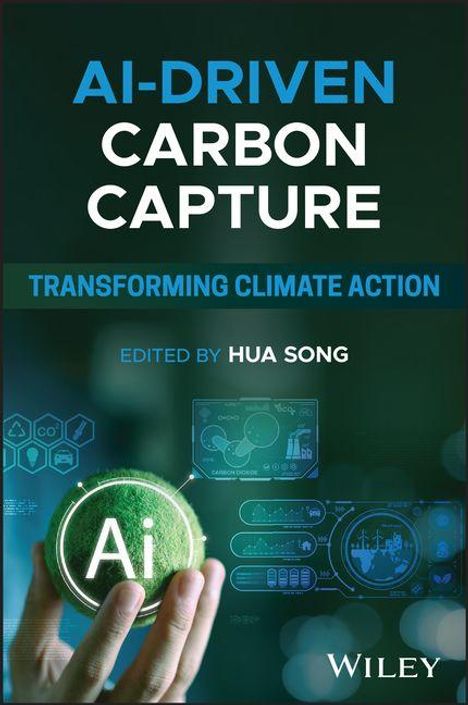
AI-Driven Carbon Capture: Transforming Climate Act ion, Gebunden
AI-Driven Carbon Capture: Transforming Climate Act ion
- Transforming Climate Action
Sie können den Titel schon jetzt bestellen. Versand an Sie erfolgt gleich nach Verfügbarkeit.
- Herausgeber:
- Hua Song
- Verlag:
- John Wiley & Sons Inc, 04/2027
- Einband:
- Gebunden
- Sprache:
- Englisch
- ISBN-13:
- 9781394268849
- Artikelnummer:
- 12810010
- Umfang:
- 320 Seiten
- Erscheinungstermin:
- 19.4.2027
- Hinweis
-
Achtung: Artikel ist nicht in deutscher Sprache!
Klappentext
Integrate AI across the full CCUS value chain
Deploying carbon capture at scale requires overcoming barriers in materials durability, energy penalty, process integration, geological uncertainty, and credible monitoring. AI-Driven Carbon Capture: Transforming Climate Action, edited by Hua Song, a chemical engineering researcher with more than 130 peer-reviewed publications, shows how machine learning, physics-informed models, digital twins, and optimization connect to real carbon-capture decisions across the entire CCUS value chain.
AI-Driven Carbon Capture covers materials discovery for solvents, sorbents, and membranes; enzymatic and biohybrid capture systems; AI-enhanced process and storage simulation; energy-efficient operation; transparent environmental accounting; and industrial case studies. The book treats AI as a powerful enabling layer while detailing the physical validation, lifecycle boundaries, uncertainty quantification, and governance frameworks required for credible, risk-aware deployment.
Readers will also find:
- Coverage of AI methods applied to deployable engineering problems including capture-route selection, process simulation, and storage monitoring
- Practical evaluation criteria such as energy penalty, net CO2 avoided, lifecycle boundaries, and audit-ready climate evidence
- Treatment of transparent AI reporting, uncertainty quantification, human authority, and risk governance for credible deployment
- Analysis of enzymatic CO2 capture integrated with machine learning for biohybrid system design and optimization
- Discussion of MRV frameworks connecting AI-enabled monitoring to carbon-market requirements and regulatory compliance
Designed for researchers, graduate students, and industrial engineers in chemical engineering, environmental engineering, energy systems, catalysis, and materials science, this book also serves technology developers, policy analysts, and sustainability professionals who need a technically grounded understanding of how AI supports credible, scalable carbon capture and climate action.