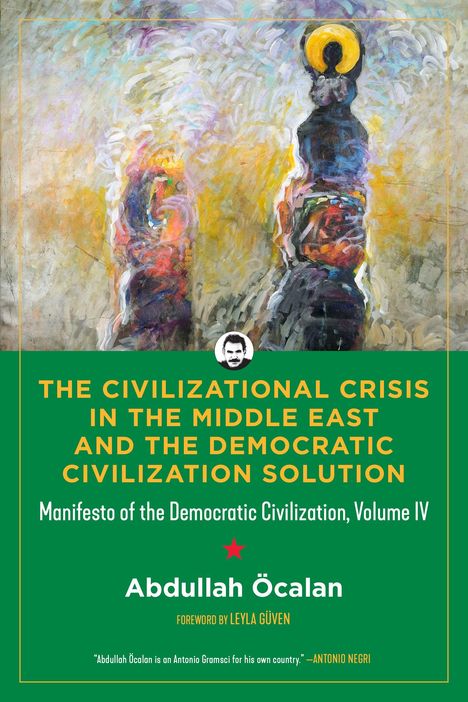
Abdullah Öcalan: The Civilizational Crisis in the Middle East and the Democratic Civilization Solution, Kartoniert / Broschiert
The Civilizational Crisis in the Middle East and the Democratic Civilization Solution
- Manifesto of the Democratic Civilization
Sie können den Titel schon jetzt bestellen. Versand an Sie erfolgt gleich nach Verfügbarkeit.
- Verlag:
- PM Press, 08/2026
- Einband:
- Kartoniert / Broschiert
- Sprache:
- Englisch
- ISBN-13:
- 9798887441931
- Artikelnummer:
- 12689131
- Umfang:
- 384 Seiten
- Erscheinungstermin:
- 18.8.2026
- Hinweis
-
Achtung: Artikel ist nicht in deutscher Sprache!
Weitere Ausgaben von The Civilizational Crisis in the Middle East and the Democratic Civilization Solution |
Preis |
|---|---|
| Buch, Gebunden, Englisch | EUR 55,84* |
Klappentext
The global crisis of civilization is nowhere more visible than in the Middle East. Wars, authoritarian regimes, social fragmentation, and ecological collapse converge into a single, devastating picture. Abdullah Öcalan argues that the solution to this crisis must be found in the same place where centralized civilization first emerged 5, 000 years ago.
The fourth volume of Öcalan's Manifesto of Democratic Civilization traces the region's deep historical crises while highlighting the many traditions of resistance---religious, cultural, communal, and antiauthoritarian---that have survived despite millennia of state domination. These traditions, he argues, provide the building blocks for a future beyond capitalist modernity.
Drawing on the theoretical framework laid out in earlier volumes, Öcalan offers a bold rereading of Middle Eastern history, revealing how patriarchy, hierarchy, and empire became entrenched, and how they can be dismantled. He presents democratic confederalism, a moral and political society, and an ecological, women-centered economic order as the essential pillars of a new civilizational model.
In this volume, Öcalan emerges not only as a strategist for resolving the Kurdish question but as a visionary for democratizing the entire region. He closes with urgent questions that speak directly to our global moment: How should we live? What must we do? And where do we begin?