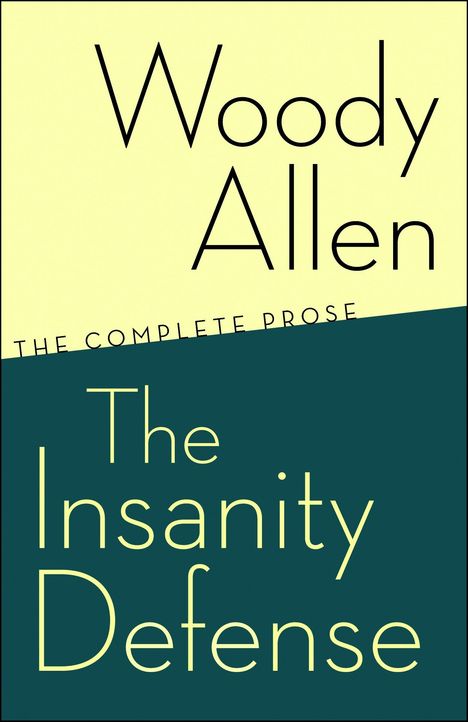
Woody Allen: The Insanity Defense: The Complete Prose, Kartoniert / Broschiert
The Insanity Defense: The Complete Prose
- The Complete Prose

(soweit verfügbar beim Lieferanten)
- Verlag:
- Random House, 06/2007
- Einband:
- Kartoniert / Broschiert
- Sprache:
- Englisch
- ISBN-13:
- 9780812978117
- Artikelnummer:
- 2211394
- Umfang:
- 352 Seiten
- Copyright-Jahr:
- 2007
- Gewicht:
- 259 g
- Maße:
- 202 x 139 mm
- Stärke:
- 20 mm
- Erscheinungstermin:
- 12.6.2007
- Serie:
- Random House Group
- Hinweis
-
Achtung: Artikel ist nicht in deutscher Sprache!
Klappentext
Comprising the classic bestsellers Getting Even, Without Feathers, and Side Effects, this definitive collection of comic writings is from a man who needs no Introduction. Really-this book has no Introduction.
The Insanity Defense reveals many sides of Woody Allen as he holds forth on the most human of urges ("Why does man kill? He kills for food. And not only for food: frequently there must be a beverage"); reflects on death ("I don't believe in an afterlife, although I am bringing a change of underwear"); and notes the effect on history wrought by trick chewing gum, the dribble glass, and other novelties. There is also an inspiring story of the futile race to beat Dr. Heimlich to the punch: "The food went down the wrong pipe, and choking occurred. Grasping the mouse firmly by the tail, I snapped it like a small whip, and the morsel of cheese came loose. If we can transfer the procedure to humans, we may have something. Too early to tell."
All Woody Allen fans will cherish this uproarious treasury-and those who don't enjoy The Insanity Defense are just plain crazy.
"If you don't care if you break into helpless whoops of laughter on buses, trains, or wherever you happen to be reading it."
-Chicago Tribune, on Without Feathers
"Brilliant flights of fancy whose comic detail and inspired silliness are at once dramatic and controlled."
-The New York Times, on Side Effects
Auszüge aus dem Buch
The Metterling Lists
Venal & Sons has at last published the long-awaited first volume of Metterling's laundry lists (The Collected Laundry Lists of Hans Metterling, Vol. I, 437 pp., plus xxxii-page introduction; indexed; $18.75), with an erudite commentary by the noted Metterling scholar Gunther Eisenbud. The decision to publish this work separately, before the completion of the immense four-volume oeuvre, is both welcome and intelligent, for this obdurate and sparkling book will instantly lay to rest the unpleasant rumors that Venal & Sons, having reaped rich rewards from the Metterling novels, play, and notebooks, diaries, and letters, was merely in search of continued profits from the same lode. How wrong the whisperers have been! Indeed, the very first Metterling laundry list
List No. 1
6 prs. shorts
4 undershirts
6 prs. blue socks
4 blue shirts
2 white shirts
6 handkerchiefs
No starch
serves as a perfect, near-total introduction to this troubled genius, known to his contemporaries as the "Prague Weirdo." The list was dashed off while Metterling was writing Confessions of a Monstrous Cheese, that work of stunning philosophi- cal import in which he proved not only that Kant was wrong about the universe but that he never picked up a check. Metterling's dislike of starch is typical of the period, and when this particular bundle came back too stiff Metterling became moody and depressed. His landlady, Frau Weiser, reported to friends that "Herr Metterling keeps to his room for days, weeping over the fact that they have starched his shorts." Of course, Breuer has already pointed out the relation between stiff underwear and Metterling's constant feeling that he was being whispered about by men with jowls (Metterling: Paranoid-Depressive Psychosis and the Early Lists, Zeiss Press). This theme of a failure to follow instructions appears in Metterling's only play, Asthma, when Needleman brings the cursed tennis ball to Valhalla by mistake.
The obvious enigma of the second list
List No. 2
7 prs. shorts
5 undershirts
7 prs. black socks
6 blue shirts
6 handkerchiefs
No Starch
is the seven pairs of black socks, since it has been long known that Metterling was deeply fond of blue. Indeed, for years the mention of any other color would send him into a rage, and he once pushed Rilke down into some honey because the poet said he preferred brown-eyed women. According to Anna Freud ("Metterling's Socks as an Expression of the Phallic Mother," Journal of Psychoanalysis, Nov., 1935), his sudden shift to the more sombre legwear is related to his unhappiness over the "Bayreuth Incident." It was there, during the first act of Tristan, that he sneezed, blowing the toupee off one of the opera's wealthiest patrons. The audience became convulsed, but Wagner defended him with his now classic remark "Everybody sneezes." At this, Cosima Wagner burst into tears and accused Metterling of sabotaging her husband's work.
That Metterling had designs on Cosima Wagner is undoubtedly true, and we know he took her hand once in Leipzig and again, four years later, in the Ruhr Valley. In Danzig, he referred to her tibia obliquely during a rainstorm, and she thought it best not to see him again. Returning to his home in a state of exhaustion, Metterling wrote Thoughts of a Chicken, and dedicated the original manuscript to the Wagners. When they used it to prop up the short leg of a kitchen table, Metterling became sullen and switched to dark socks. His housekeeper pleaded with him to retain his beloved blue or at least to try brown, but Metterling cursed her, saying, "Slut! And why not Ar- gyles, eh?"
In the third list
List No. 3
6 handkerchiefs
5 undershirts
8 prs. socks
Biografie
Woody Allen, geboren als Allen Stewart Konigsberg in New York, lebt in Manhattan; ist Autor, Regisseur, Schauspieler, Musiker, Intellektueller und gefeierter Film-Komiker unserer Zeit; Hollywood verlieh ihm 4 Oscars.