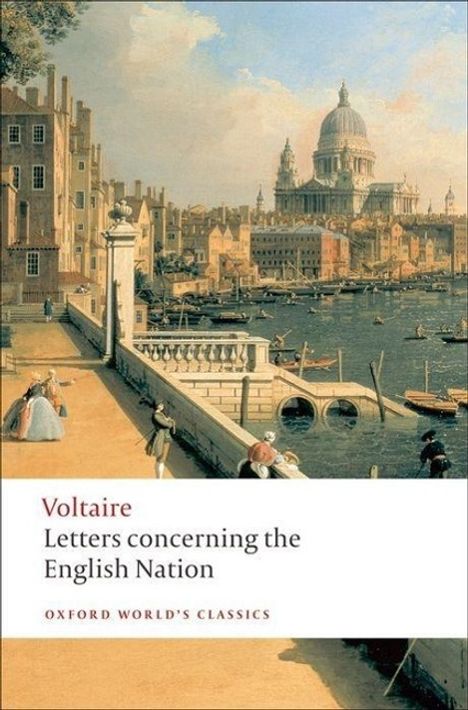
Voltaire: Letters concerning the English Nation, Kartoniert / Broschiert
Letters concerning the English Nation
(soweit verfügbar beim Lieferanten)
- Herausgeber:
- Nicholas Cronk
- Verlag:
- Oxford University Press, 07/2009
- Einband:
- Kartoniert / Broschiert
- Sprache:
- Englisch
- ISBN-13:
- 9780199555321
- Artikelnummer:
- 5231529
- Umfang:
- 240 Seiten
- Gewicht:
- 172 g
- Maße:
- 196 x 129 mm
- Stärke:
- 12 mm
- Erscheinungstermin:
- 30.7.2009
- Serie:
- Oxford World's Classics
- Hinweis
-
Achtung: Artikel ist nicht in deutscher Sprache!
Weitere Ausgaben von Letters concerning the English Nation |
Preis |
|---|
Klappentext
Inspired by Voltaire's two-year stay in England (1726-8), this is one of the key works of the Enlightment. Exactly contemporary with Gulliver's Travels and The Beggar's Opera, Voltaire's controversial pronouncements on politics, philosophy, religion, and literature have place the Letters among the great Augustan satires.
Voltaire wrote most of the book in English, in which he was fluent and witty, and it fast became a bestseller in Britain. He re-wrote it in French as the Lettres philosophiques, and current editions in English translate his French. This edition restores for the modern reader Voltaire's own English text, allowing us to appreciate him as a stylist at first hand. It is the only critical edition of the original text and, as well as providing an introduction and notes, it includes intriguing accounts of Voltaire by contemporary English ovservers.
ABOUT THE SERIES: For over 100 years Oxford World's Classics has made available the widest range of literature from around the globe. Each affordable volume reflects Oxford's commitment to scholarship, providing the most accurate text plus a wealth of other valuable features, including expert introductions by leading authorities, helpful notes to clarify the text, up-to-date bibliographies for further study, and much more.
Biografie (Voltaire)
Voltaire, eig. François-Marie Arouet, geb. 1694 in Paris, besuchte dort das Jesuitenkolleg Louis-le-Grand und fand nach Abschluß seines Studiums bald Zugang zu aristokratischen freidenkerischen Kreisen. 1717 brachte ihm eine Satire auf Ludwig XIV. ein Jahr Haft in der Bastille ein. Später mußte er seines Freidenkertums und seiner aufklärerischen Schriften wegen mehrfach Paris verlassen. In England und auf dem Schloß einer Freundin in der Champagne fand er Asyl. 1750 folgte er einer Einladung an den Hof Friedrich des Großen, wurde aber drei Jahre später in Ungnade wieder entlassen. Er starb 1778 in Paris.