
Johann Sebastian Bach: Johannes-Passion (Bearbeitung von Robert Schumann)
Johannes-Passion (Bearbeitung von Robert Schumann)
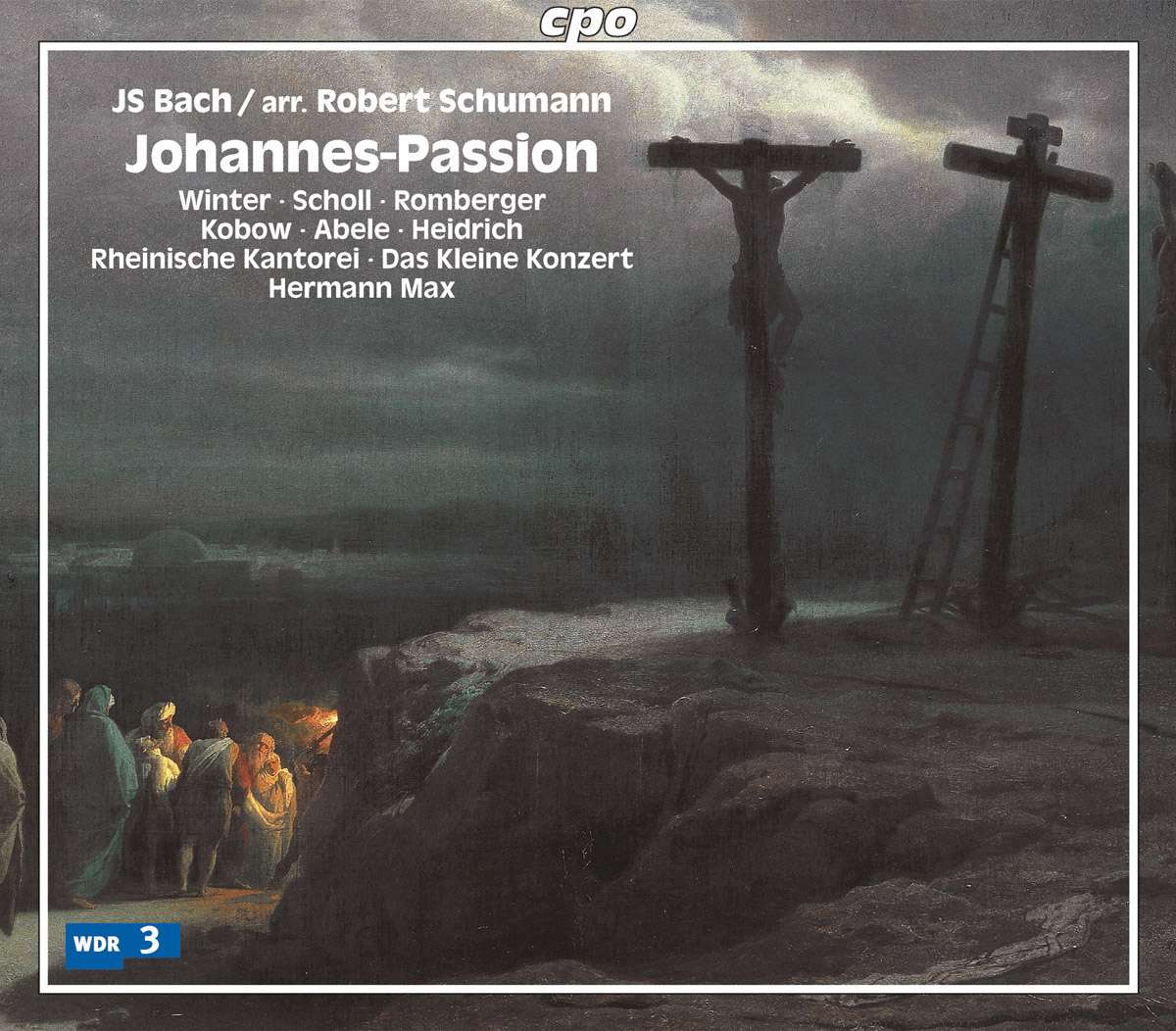
Veronika Winter, Elisabeth Scholl, Gerhild Romberger, Jan Kobow, Ekkehard Abele, Clemens Heidrich, Rheinische Kantorei, Das Kleine Konzert, Hermann Max
2
Super Audio CDs
SACD (Super Audio CD)
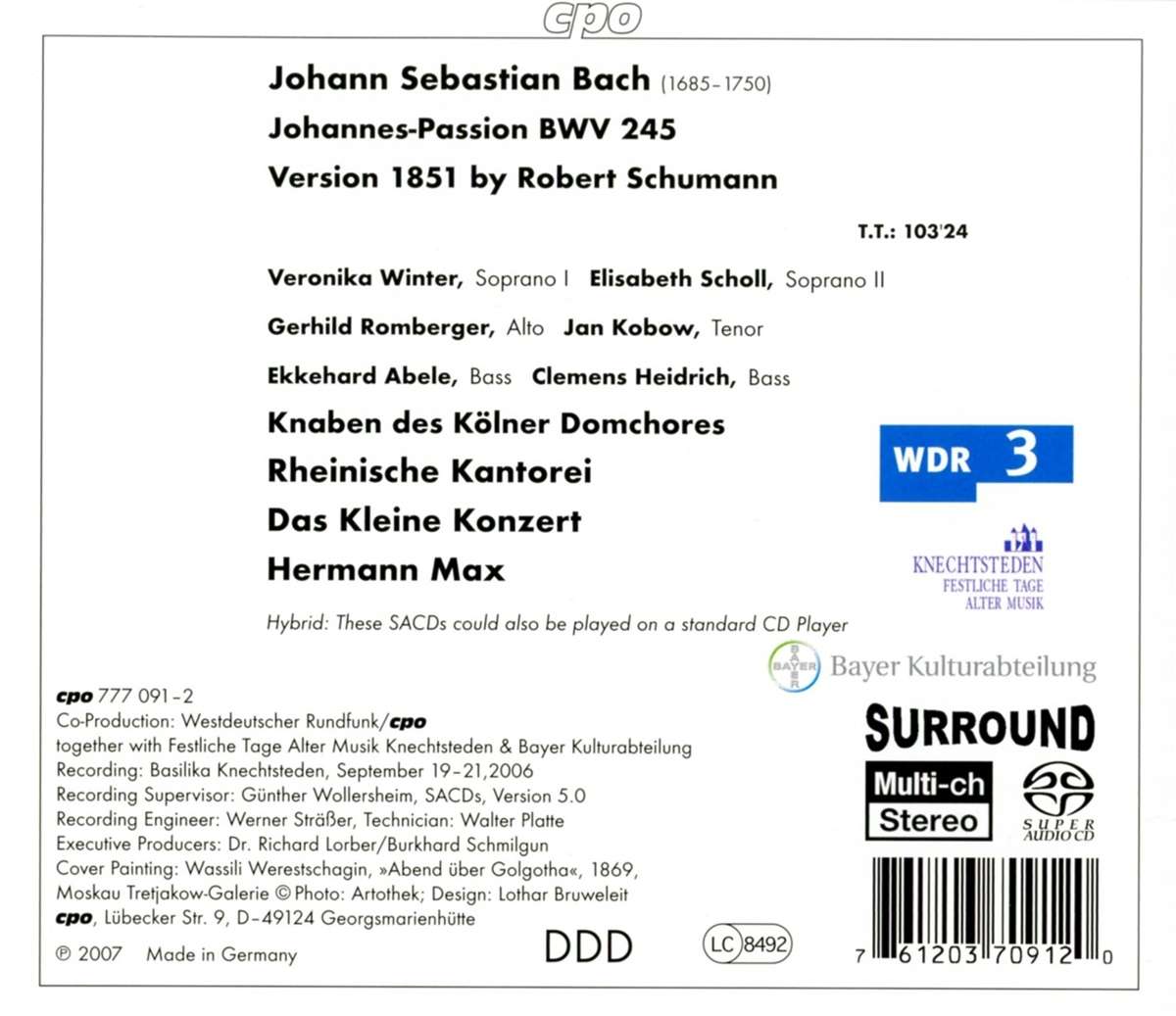
Die SACD verwendet eine höhere digitale Auflösung als die Audio-CD und bietet außerdem die Möglichkeit, Mehrkanalton (Raumklang) zu speichern. Um die Musik in High-End-Qualität genießen zu können, wird ein spezieller SACD-Player benötigt. Dank Hybrid-Funktion sind die meisten in unserem Shop mit "SACD" gekennzeichneten Produkte auch auf herkömmlichen CD-Playern abspielbar. Dann allerdings unterscheidet sich der Sound nicht von einer normalen CD. Bei Abweichungen weisen wir gesondert darauf hin (Non-Hybrid).
- Tonformat: stereo & multichannel (hybrid)
- Künstler: Veronika Winter, Elisabeth Scholl, Gerhild Romberger, Jan Kobow, Ekkehard Abele, Clemens Heidrich, Rheinische Kantorei, Das Kleine Konzert, Hermann Max
- Label: CPO, DDD, 2006
- Bestellnummer: 6391959
- Erscheinungstermin: 14.3.2007





Zum Inhalt der CD:
Bach aus Schumanns Sicht
1829 hatte Mendelssohn die Matthäus-Passion in Berlin zur ersten öffentlichen Wiederaufführung im 19. Jahrhundert gebracht, und damit überhaupt Bach wieder in das Bewusstsein der Öffentlichkeit gebracht. Das befreundete Ehepaar Schumann griff begierig diese Entdeckung auf: für Robert wurde Bach noch mehr zum Zentrum alles Schaffens als für Mendelssohn. Was die Passionen betrifft, so fiel seine Vorliebe allerdings auf die Johannes-Passion, der Mendelssohn sich nie gewidmet hatte. Als Schumann 1850 das Angebot erhielt, als Musikdirektor nach Düsseldorf zu kommen, war sein erstes Hauptprojekt die dort bis dahin nie aufgeführte Johannes-Passion im April 1851. ». . . . sie ist um vieles kühner, gewaltiger, poetischer als die nach Matthäus. Diese scheint mir nicht frei von Breiten und über das Maß lang – die andere dagegen wie gedrängt, wie durchaus genial, und von welcher Kunst!« Wie Mendelssohn passte Schumann die Bachsche Musiksprache seiner eigenen Zeit an, ersetzte Instrumente, die nicht mehr gebräuchlich waren, orchestrierte um etc. Hermann Max hat jetzt eine Rekonstruktion dieser denkwürdigen künstlerischen Anverwandlung vorgenommen.
Bach from Schumann’s Perspective
Felix Mendelssohn’s performance of the St. Matthew Passion in Berlin in 1829 was the first new presentation of this work in the nineteenth century. It once again made Bach a known quantity in the larger music world, and Mendelssohn’s friends Robert and Clara Schumann responded eagerly and enthusiastically to this rediscovery. Bach’s music came to occupy more of a central position for Schumann than for Mendelssohn. As far as Bach’s passions were concerned, Schumann preferred the St. John Passion, with which Mendelssohn never occupied himself. When Schumann was offered the post of music director in Duesseldorf in 1850, his first main project was to perform the St. John Passion, which had never been presented there, in April 1851: »It is much bolder, more powerful, and more poetic than the St. Matthew. This one seems to me not to be free of diffuseness and to be exceedingly long, but the other – how compact, how thoroughly genial, and of what art!« Like Mendelssohn, Schumann adapted Bach’s musical language to his own times, replaced instruments that were no longer in use, and orchestrated the original anew – together with other changes. Hermann Max has now undertaken a reconstruction of this remarkable artistic assimilation.
Bach aus Schumanns Sicht
1829 hatte Mendelssohn die Matthäus-Passion in Berlin zur ersten öffentlichen Wiederaufführung im 19. Jahrhundert gebracht, und damit überhaupt Bach wieder in das Bewusstsein der Öffentlichkeit gebracht. Das befreundete Ehepaar Schumann griff begierig diese Entdeckung auf: für Robert wurde Bach noch mehr zum Zentrum alles Schaffens als für Mendelssohn. Was die Passionen betrifft, so fiel seine Vorliebe allerdings auf die Johannes-Passion, der Mendelssohn sich nie gewidmet hatte. Als Schumann 1850 das Angebot erhielt, als Musikdirektor nach Düsseldorf zu kommen, war sein erstes Hauptprojekt die dort bis dahin nie aufgeführte Johannes-Passion im April 1851. ». . . . sie ist um vieles kühner, gewaltiger, poetischer als die nach Matthäus. Diese scheint mir nicht frei von Breiten und über das Maß lang – die andere dagegen wie gedrängt, wie durchaus genial, und von welcher Kunst!« Wie Mendelssohn passte Schumann die Bachsche Musiksprache seiner eigenen Zeit an, ersetzte Instrumente, die nicht mehr gebräuchlich waren, orchestrierte um etc. Hermann Max hat jetzt eine Rekonstruktion dieser denkwürdigen künstlerischen Anverwandlung vorgenommen.
Product Information
Bach from Schumann’s Perspective
Felix Mendelssohn’s performance of the St. Matthew Passion in Berlin in 1829 was the first new presentation of this work in the nineteenth century. It once again made Bach a known quantity in the larger music world, and Mendelssohn’s friends Robert and Clara Schumann responded eagerly and enthusiastically to this rediscovery. Bach’s music came to occupy more of a central position for Schumann than for Mendelssohn. As far as Bach’s passions were concerned, Schumann preferred the St. John Passion, with which Mendelssohn never occupied himself. When Schumann was offered the post of music director in Duesseldorf in 1850, his first main project was to perform the St. John Passion, which had never been presented there, in April 1851: »It is much bolder, more powerful, and more poetic than the St. Matthew. This one seems to me not to be free of diffuseness and to be exceedingly long, but the other – how compact, how thoroughly genial, and of what art!« Like Mendelssohn, Schumann adapted Bach’s musical language to his own times, replaced instruments that were no longer in use, and orchestrated the original anew – together with other changes. Hermann Max has now undertaken a reconstruction of this remarkable artistic assimilation.
Rezensionen
Concerto 10/07: »Mit den hervorragenden Solisten, allen voran Jan Kobow als ausgewiesener Evangelist, gelingt Max eine Aufnahme, die dem Hörer aus ungewohnter historischer Perspektive erstaunliche Einblicke in Bachs Johannes-Passion vermitteln kann. Ganz gewiss ein wertvoller und lohnender Beitrag mit hohem editorischen Wert!« Hessisch-Niedersächsische Allgemeine 01/08: »Eine beeindruckende Neuaufnahme. Das Ergebnis ist keine romantische Barockpolyfonie, sondern ein neuer Blickwinkel auf das Schaffen des Thomaskantors.« Toccata 03/08: »Mit dieser Produktion wird ein wichtiges Ereignis in der Geschichte der Bach-Pflege dokumentiert.«- Tracklisting
- Details
- Mitwirkende
Disk 1 von 2 (SACD)
Johannes-Passion BWV 245 (Oratorium) (Gesamtaufnahme) (bearb. von Robert Schumann)
- 1 Chor: Herr, unser Herrscher (1. Teil)
- 2 Rezitativ: Jesus ging mit seinen Jüngern
- 3 Choral: O große Lieb
- 4 Rezitativ: Auf dass das Wort erfüllet würde
- 5 Choral: Dein Will gescheh
- 6 Rezitativ: Die Schar aber und der Oberhauptmann
- 7 Arie: Von den Stricken meiner Sünden
- 8 Rezitativ: Simon Petrus aber folgte Petrus nach
- 9 Arie: Ich folge dir gleichfalls
- 10 Rezitativ: Derselbige Jünger war dem Hohenpriester bekannt
- 11 Choral: Wer hat dich so geschlagen
- 12 Rezitativ: Und Hannas sandte ihn gebunden
- 13 Arie: Ach, mein Sinn, wo willt du endlich hin
- 14 Choral: Petrus, der noch denkt zurück
- 15 Choral: Christus, der uns selig macht (2. Teil)
- 16 Rezitativ: Da führetem sie Jesum von Kaiphas vor das Richthaus
- 17 Choral: Ach, großer König, groß zu allen Zeiten
- 18 Rezitativ: Da sprach Pilatus zu ihm
- 19 Arioso: Betrachte, mein Seel, mit ängstlichem Vergnügen
- 20 Arie: Mein Jesu, ach!
- 21 Rezitativ: Und die Kriegsknechte flochten eine Krone
- 22 Choral: Durch dein Gefängnis, Gottes Sohn
Disk 2 von 2 (SACD)
- 1 Rezitativ: Die Jüden aber schrieen
- 2 Arie: Eilt, ihr angefochtnen Seelen
- 3 Rezitativ: Allda kreuzigten sie ihn
- 4 Choral: In meines Herzens Grunde
- 5 Rezitativ: Die Kriegsknechte aber
- 6 Choral: Er nahm alles wohl in acht
- 7 Rezitativ: Und von Stund an nahm sie den Jünger zu sich
- 8 Arie: Es ist vollbracht
- 9 Rezitativ: Und neiget das Haupt und verschied
- 10 Arie: Mein teurer Heiland, lass dich fragen
- 11 Rezitativ: Und siehe da, der Vorhang im Tempel zerriss
- 12 Arioso: Mein Herz
- 13 Arie: Zerfließe, mein Herze
- 14 Rezitativ: Die Jüden aber
- 15 Choral: O hilf, Christe, Gottes Sohn
- 16 Rezitativ: Darnach hat Pilatum Joseph von Arimathia
- 17 Chor: Ruht wohl, ihr heiligen Gebeine
- 18 Choral: Ach Herr, laß dein lieb Englein
Mehr von Johann Sebastia...
Johann Sebastian Bach
Sämtliche Konzerte (Concerto Copenhagen)
5 CDs
EUR 24,99*

Johann Sebastian Bach
Brandenburgische Konzerte Nr.1-6
2 Super Audio CDs
EUR 19,99*

Johann Sebastian Bach
Die Kunst der Fuge BWV 1080 für 4 Saxophone (180g)
EUR 19,99**
2 LPs
EUR 12,99*

Johann Sebastian Bach
Messe h-moll BWV 232
EUR 19,99**
2 Super Audio CDs
EUR 14,99*

Johann Sebastian Bach
Sämtliche Orgelwerke
EUR 49,99**
22 CDs
EUR 29,99*