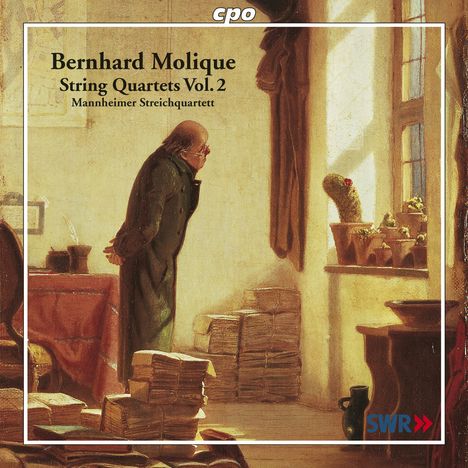
Wilhelm Bernhard Molique: Streichquartette op.18 Nr.3 & op.28 auf CD
Streichquartette op.18 Nr.3 & op.28
Herkömmliche CD, die mit allen CD-Playern und Computerlaufwerken, aber auch mit den meisten SACD- oder Multiplayern abspielbar ist.
Lassen Sie sich über unseren eCourier benachrichtigen, falls das Produkt bestellt werden kann.
- Künstler:
- Mannheimer Streichquartett
- Label:
- CPO
- Aufnahmejahr ca.:
- 2006
- UPC/EAN:
- 0761203727629
- Erscheinungstermin:
- 27.4.2009
Online anhören






Ähnliche Artikel


Molique Streichquartette Vol. 2
Auch wenn er bei vielen seiner Zeitgenossen und Kollegen als "trockener Gesell" oder "Spießbürger" galt, so war Bernhard Molique doch auch einer der größten zeitgenössischen Violinisten. Tourneen durch ganz Europa machten ihn zu einer europäischen Berühmtheit. Im Zentrum seines kompositorischen Schaffens stehen aber seine Streichquartette, die sich wider ersten Erwartens als Meisterwerke im Spannungsfeld von Klassik und Romantik zeigen. Bei dem Quartett op. 18, 3 scheint es, als habe Molique im Gegensatz zu dem ersten und zweiten Quartett dieses Opus einen weiteren Schritt in Richtung Romantik getan, ohne jedoch das klassische Bewusstsein aus den Augen zu verlieren. Das andere Quartett op. 28 erschien erst drei Jahre nach op. 18 und zeigt uns mit der düster- schwermütigen Tonart f-moll eine weitere Facette von Molique. Das Mannheimer Streichquartett beweist einmal mehr, dass es eine Formation ist, „ die die Partituren im besten Licht erstrahlen lässt." (FonoForum 1 / 06 zu Vol. 1)
Product Information
Molique’s String Quartets Vol. 2
Even though Bernhard Molique may have been regarded as a »dull fellow« or »philistine«
by many of his contemporaries, he was nevertheless one of the greatest violinists of his times.
Tours throughout Europe brought him international renown. The center of his compositional
oeuvre, however, is occupied by his string quartets, which, contrary to our initial expectations,
prove to be masterpieces between the poles of classicism and romanticism. The Quartet
op. 18, 3 stands out from the first and second numbers of this opus in that in it Molique seems
to have taken a large step toward romanticism – but without losing sight of the classical
consciousness. The Quartet op. 28 published three years after op. 18 shows us another facet
of Molique with its gloomy and melancholy F minor key. The Mannheim String Quartet
demonstrates once again that it is an ensemble »that lets the scores shine in their best light«
(FonoForum 1 / 06 of Vol. 1).
Disk 1 von 1 (CD)
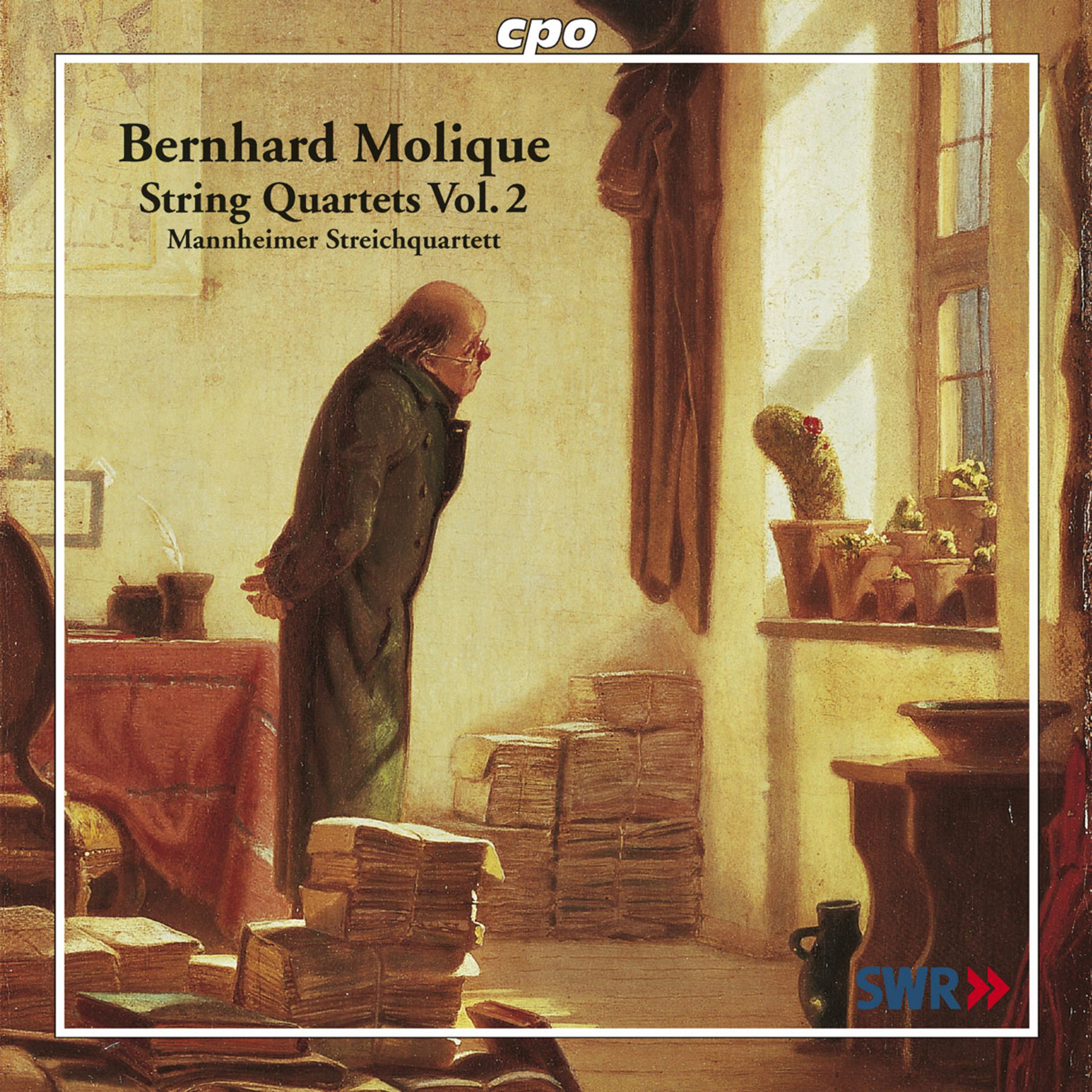
Streichquartett Es-Dur op. 18 Nr. 3
-
1 1. Allegro
-
2 2. Andante
-
3 3. Menuetto
-
4 4. Presto
Streichquartett f-moll op. 28
-
5 1. Allegro
-
6 2. Andante
-
7 3. Scherzo
-
8 4. Rondo
Mehr von Wilhelm Bernhar...
-
Wilhelm Bernhard MoliqueSämtliche Streichquartette4 CDsAktueller Preis: EUR 19,99
-
Wilhelm Bernhard MoliqueViolinkonzerte Nr.3 d-moll op.10 & Nr.6 e-moll op.30CDAktueller Preis: EUR 19,99
-
Wilhelm Bernhard MoliqueKammermusik Vol.1CDVorheriger Preis EUR 21,99, reduziert um 0%Aktueller Preis: EUR 19,99
-
Wilhelm Bernhard MoliqueKammermusik Vol.2CDAktueller Preis: EUR 19,99