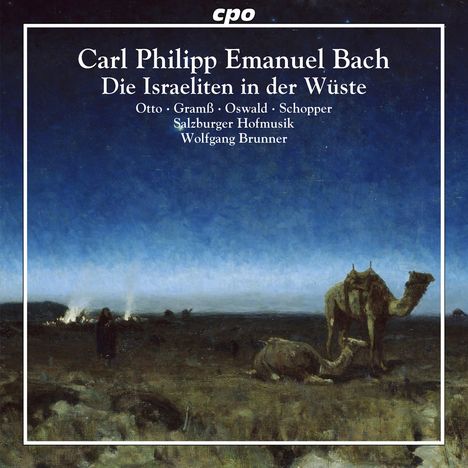
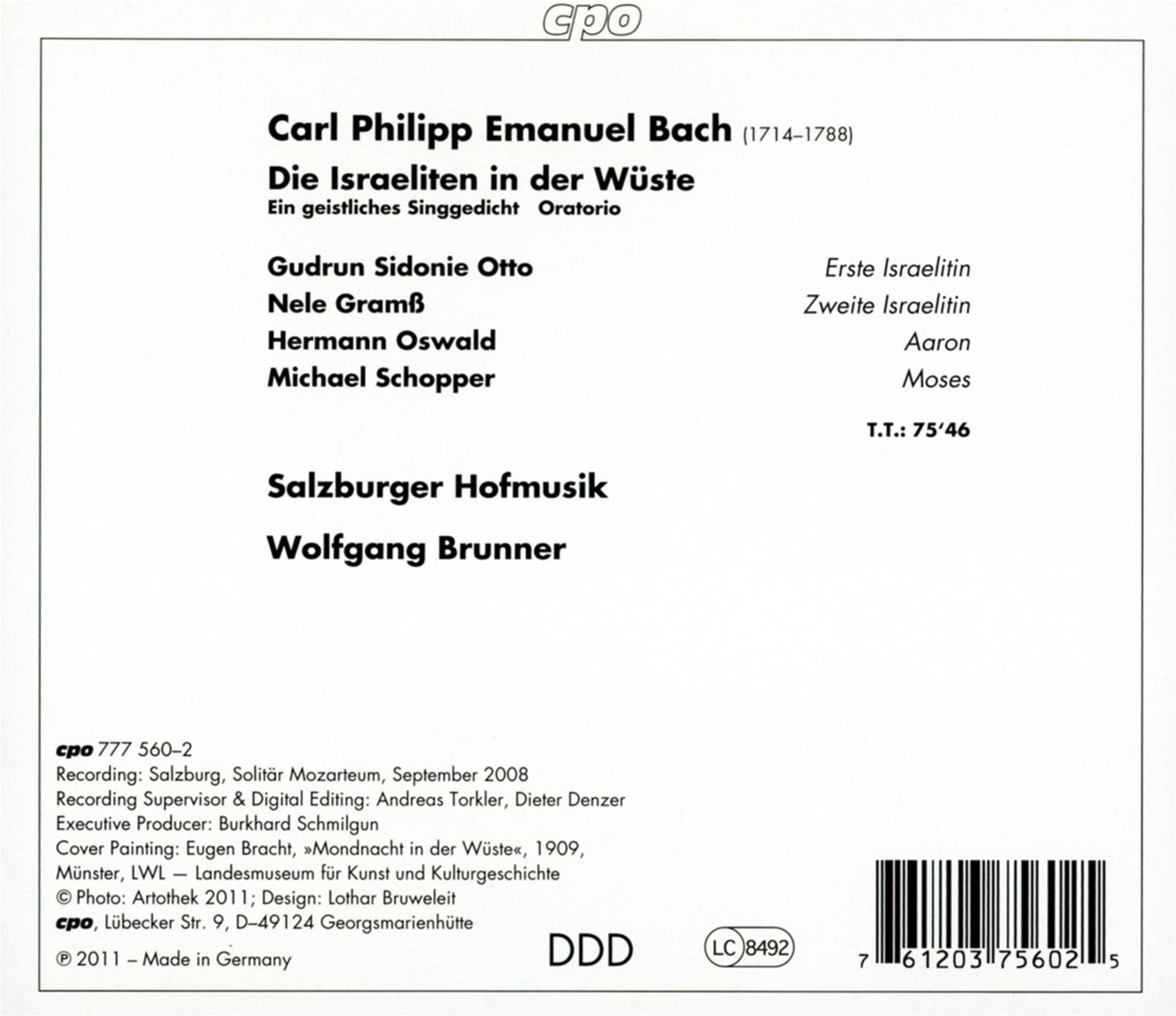
Carl Philipp Emanuel Bach: Die Israeliten in der Wüste Wq 238 auf CD
Die Israeliten in der Wüste Wq 238
Herkömmliche CD, die mit allen CD-Playern und Computerlaufwerken, aber auch mit den meisten SACD- oder Multiplayern abspielbar ist.

Lassen Sie sich über unseren eCourier benachrichtigen, falls das Produkt bestellt werden kann.
- Künstler:
- Gudrun Sidonie Otto, Nele Gramß, Hermann Oswald, Michael Schopper, Salzburger Hofmusik, Wolfgang Brunner
- Label:
- CPO
- Aufnahmejahr ca.:
- 2008
- UPC/EAN:
- 0761203756025
- Erscheinungstermin:
- 5.12.2011
Online anhören






Ähnliche Artikel


CPE Bachs dramatisches Oratorium
Carl Philipp Emanuel Bach schrieb seine „Israeliten in der Wüste“ unmittelbar nach seinem Amtsantritt 1768 / 69, als er von (seinem Paten) Georg Philipp Telemann dessen Amt des Hamburger Musikdirektors übernommen hatte. Bei seiner musikalischen Visitenkarte wählte er einerseits ein Sujet, das ihm eine breite Palette an Ausdrucksmöglichkeiten bot, er komponierte aber auch ein neutrales Thema, das konfessionell nicht festgelegt war. Der erste Teil entfaltet theatralische Wirkungen, der zweite dient der geistlichen Vertiefung des Erlebten. Das Thema musste Bach schon allein aus seiner Ästhetik der Empfindsamkeit und des Sturm und Drang heraus gereizt haben: Menschen in extremen Lebenssituationen textlich und musikalisch zu schildern. Die Zeitgenossen waren begeistert: Reichardt schrieb: „...wie gewaltig das Geschrey des verzweifelten Volkes, wie originell der Ausdruck seines Hohnes gegen Gott, wie majestätisch die Sprache Mosis und wie flehentlich sein Gebet, wie lieblich die ganze letzte Scene gegen die erstern grauenvollen erbärmlichen Scenen absticht...“
Product Information
C. P. E. Bach’s Dramatic Oratorio
Carl Philipp Emanuel Bach wrote his Israeliten in der Wüste immediately after assuming the post of Hamburg City Music Director in 1768 / 69, succeeding his godfather Georg Philipp Telemann. As his musical visiting card he selected a subject offering him a broad palette of expressive possibilities and a neutral theme transcending the limits of a particular religious confession. The first part develops theatrical effects, and the second serves toward the spiritual deepening of the events experienced. The theme must have appealed to Bach already on the basis of his aesthetic combining Empfindsamkeit and the Sturm und Drang: here he had the opportunity to depict human beings in life’s extreme situations and to do so both textually and musically. His contemporaries were enthused, and Reichardt wrote, »How mighty the shout of the despairing people, how original the expression of their scorn toward God, how majestic the language of Moses and how imploring his prayer, how delightfully the whole last scene stands apart from the earlier horribly pitiable scenes!«
Rezensionen
klassik-heute. com 04/12: »Gewiss: Solche kontroversen musikalischen Ebenen können nur in einer erstklassigen Aufführung vollends zur Geltung kommen, und die Interpreten dieser Aufnahme tragen alle zum herausragenden Gesamteindruck bei. Solisten, Chor und Instrumentalensemble bieten eine in der Stimmführung und Artikulation beispielhaft akzentuierte, lebhafte und ausdrucksstarke Wiedergabe.«Disk 1 von 1 (CD)
Die Israeliten in der Wüste (Oratorium)
-
1 Chor: Die Zunge klebt am dürren Gaumen
-
2 Rezitativ: Ist dieses Abrams Gott?
-
3 Arie: Will er, dass sein Volk verderbe?
-
4 Rezitativ: Verehrt des Ew'gen Willen
-
5 Arie: Bis hieher hat er euch gebracht
-
6 Rezitativ: Warum verließen wir Ägyptens blühendes Land?
-
7 Arie: O! Bringet uns zu jenen Mauern
-
8 Rezitativ: Für euch fleht Moses stets
-
9 Sinfonie
-
10 Rezitativ: Welch ein Geschrei tönt in mein Ohr?
-
11 Chor: Du bist der Ursprung unser Not
-
12 Rezitativ: Undankbar Volk
-
13 Duett: Umsonst sind unsre Zähren
-
14 Accompagnato: Gott, meiner Väter Gott
-
15 Arie: Gott, sieh Dein Volk im Staube liegen
-
16 Chor: O Wunder!
-
17 Rezitativ: Verdienet habt ihr ihn, den Zorn des Herren
-
18 Chor: Gott Israels, empfange in jauchzenden Gesange
-
19 Rezitativ: Wie nah war uns der Tod!
-
20 Arie: Vor des Mittags heißen Strahlen
-
21 Accompagnato: O Freunde, Kinder
-
22 Rezitativ: Beneidenswert, die ihren Sohn ihn nennt
-
23 Arie: O selig, wem der Herr gewähret
-
24 Rezitativ: Hofft auf den Ew'gen
-
25 Chor: Verheissner Gott
-
26 Choral: Was der alten Väter Schaar
-
27 Rezitativ: Oh Heil der Welt
-
28 Chor: Lass Dein Wort
Mehr von Carl Philipp Em...
-
Carl Philipp Emanuel BachHamburger Quartalsmusiken2 CDsVorheriger Preis EUR 14,99, reduziert um 0%Aktueller Preis: EUR 9,99
-
Carl Philipp Emanuel BachHamburgische FestmusikenCDAktueller Preis: EUR 7,99
-
Johann Gottlieb GraunViolakonzert Es-Dur WV C:XIII:116CDVorheriger Preis EUR 17,99, reduziert um 0%Aktueller Preis: EUR 7,99
-
Carl Philipp Emanuel Bach6 KlaviertriosCDAktueller Preis: EUR 7,99